Claim your Pantaloon Freedom

office shorts (1).jpg

On standing up from my desk chair, I immediately felt the unexpected gaze of my colleagues. Some of the looks were based on admiration; others on envy, there was even the occasional involuntary gasp of astonishment. However, to me, the experience was refreshing and reminded me very much of my younger days.

Regardless of your sex, you have all experienced the feeling. It was in the days when we were unashamed to flaunt it all, our bare skin, free to the world, purposefully unhidden below any wads of consolidated fibres of corporate cloth.

We wore our innovative adventures with pride, and accumulated countless scars that testified our forays into the carefree and creative world in which we lived, unperturbed about the potential future consequences.

In our unprotected state, we immediately experienced the changing moods of our surrounding environment. For those of us with an abundance of hairs, these quickly stood erect in complete barometric harmony with the prevailing climatic conditions.

Yes, we were the wearers of shorts and our knees relished in their uncovering.

But at a certain age, our lives changed significantly when we decided, or were instructed by those that knew better, to wear trousers. At this point in time we became pantaloon conformists. No longer would our knees enjoy that continual breeze woft that symbolised our youthful exhilaration of openness.

As the years progressed, that haphazard child-like naivety and knee-free explorative thought slowly became extinct, particularly for those in the corporate office who habitually and unthinkingly wear a suit.

But relax, yours knees are quite resilient and will with the right air stimulation quickly revert back to their native state of youthfulness and inspiration. The corrective process is simple, just start wearing shorts in the office.

Don’t worry yourself about rules of fashion, you can wear long walk socks, short ankle length socks, or go ankle commando.

For that professional look, a tailored short does look the best, together with the belt that used to reside in your conservative suit trousers that will instantaneously welcome your new, and refreshing lease of life, now less rigidly “waistful”. Should you wear a business shirt, tie or jacket with your shorts? The choice is entirely up to you, but definitely not the corporate branded T-shirt, as you will want to vehemently maintain the creative personal innovation that your knees have fought so hard to physically obtain.

Yes, I was enjoying the experience of wearing shorts in the corporate office. My knees were once again unhindered, and so was my thought. In direct thoughtful knee correlation, my mind now gratefully welcomed its cloth shackle-less freedom, and acknowledged that I had once again rediscovered my true source of innovation.

The Lazy Creative

maxresdefault-1

It can happen via a deliberate wrist glance, a nonchalant button press, or the frequent refreshing of a specifically purchased iPhone App. You have all observed it in action. Yes, it’s the now quite common hourly habit of the corporate office FITBIT wearer as they compete with their fellow fanatical walkers for the esteemed victor of the Workweek Hustle.

But in a recent study, at a soon to be prestigious Australian Institute of Sport, a rather unusual finding has been discovered that has found a direct correlation with a person’s aptitude for innovation, and their FITBIT daily step count. Contrary to what you may think, the lower the FITBIT number, the higher the innovation intellect.

The majority of the corporate office population view those in their working ranks with a very Low FITBIT Step Count (LFSC) as being rather lazy. However, the study results found this to be remarkably furthest from the truth.

Those of your colleagues with a LFSC typically commenced their innovation training early in their youth as a teenager. A visual clue to their future LFSC creative talent would be their clothes, towels and food plates being strategically placed on the floor in their bedrooms. As the days of litter and odour progressed unhindered, a frustrated parent would finally succumb to the mess and tidy their room, with no stepping activity required at all from the clever child.

For teenagers that mastered this skill, their LFSC innovative prowess continued into their working life where the role of the parent was replaced by a fellow work colleague. Here they would sit comfortably at their desk, with their ears and eyes seeking out a potential parental worker surrogate to ensure that their need for physical exertion was significantly minimized. If you are not familiar with their innovative FITBIT step reduction techniques, take note of the following behavioural clues:

  1. The Coffee Run: They will hear the murmurings of colleagues thinking of making a dash to the nearest café for a coffee. Using their creative talent, they will feign extreme busyness and will ask you to get them a coffee on their behalf. If they are masterly at their LFSC craft, you will also be paying for them, with no hope or expectation of a reciprocal arrangement.
  1. The Carpark: In the office carpark, the innovative LFSC colleague will park in the closest position next to the elevator thereby ensuring the least number of walking steps. Some may even place a “Reserved” sign to guarantee this requirement.
  1. The Video Conference: Rather than having to walk to a meeting, the LFSC colleague will cunningly schedule a video conference, even if the colleagues invited sit only a few desks away.

So next time you have a FITBIT Workweek Hustle and you power your way on a daily basis to stepping superiority, may I suggest that you have a look at the work colleague that always comes last. Yes, they are the truly innovative people in your corporate office as it takes creative ingenuity to be that lazy!

The Tasteful Application of the iChup™

chupachuppencil-1

A soon to be conducted research study by a famous, yet remarkably unpretentious University located near Oxford, has yielded a highly plausible theory regarding the primary catalyst that supports a truly innovative mind.

The theory examined the resources used by the leading creative thinkers prevalent in the 1940s with those commonly found today, and the results were indisputable.

The majority of the great thinkers of the 1940s relied on a common, and most readily available thinking tool that transcribed their thoughts onto paper for private contemplation, mass distribution, and eventual critique amongst their peers. This tool was highly malleable and could be customised to the palate of the holder following long thoughtful periods of mastication. The tool was typically made from wood, with a pointed graphite core that blunted with continual use. Its name was the pencil.

However, with the advent of the computer, the role of the pencil slowly disappeared from the hand of the thinking person and was surreptitiously replaced with the keyboard, and the mouse.

The researchers, from that University located near Oxford, spent many hours studying the chewing habits of a small, yet highly representative sample of computer users (about three actually). Those observed, were found to exhibit no visible characteristics of creativity, but more importantly, not one of them placed any IT implement in their mouth. Besides shouting the letters Q.E.D. (quod erat demonstrandum) quite loudly following this remarkable observation, they smugly realised that they had indeed discovered the true supportive tool for innovation.

Yes, there is a direct correlation between those with a creative mind, and those that thoughtfully chew a pencil.

A few years later, a Research Scientist at Apple just happened to read the findings of this chewing link to innovation and a strategic project was immediately funded. Following the expenditure of many millions of dollars, the consumption of endless cups of soy-milk chai lattes with honey, the iChup™ was finally invented, even more quickly commercialised, and can now be seen in the mouths of many innovative computer users today.

As the name suggests, the iChup™ does have the appearance of a Chupa Chup, and the method of operation is indeed via mouth placement, but that is as far as the similarly goes as the iChup™ has many more mind pleasing features.

Feature 1: Bluetooth Connectivity
The iChup™ has a small surface sensor that measures the tension applied by your teeth as the device is gleefully moved around your mouth thereby ensuring minimal dental damage. The measurement output can be linked via Bluetooth to your computer, or your mobile phone utilising the iChup™ App.

Feature 2: Stress Relaxation
For those thinkers that are stressed, the iChup™ has been designed for under tongue placement. Once in position, the iChup™ has a range of vibration settings that can be selected by the user to obtain maximum stress relaxation.

Feature 3: Taste
The iChup™’s hollow centre has been designed to accommodate a variety of tasteful liquids that are pleasantly discharged over an 8 hour workday. A range of flavours can be purchased, the more popular ones being mint, cola, honey, and for those that like the taste of pencils, there is even a special wooden one.

The iChup™ has been a real success for Apple and one that reinforces that old saying; “Don’t Forget the Past. Learn from It”.

And yes, I still like to use a pencil, still have the taste for it, and find that many creative thoughts quickly appear when applied to paper.

The Office Well-Being Executive Manager

RetroWoman1950sStyle-Attrib-Flickr-MipsyRetro-5593568015-640x604

The corridors of corporate life used to experience it at least once a day, typically around 3 PM. Those of you with a longer memory say it also occurred in the morning, but alas, those days are reluctantly gone, possibly, never to be repeated.

The eagerly awaited activity heralded an opportunity to have a short break from your normal work routine and to refresh your mind with small morsels of needed sustenance.

It was a welcome time for all pens to be lowered, inky nibs blotted, and writing paper pushed aside on your desk to make room for the appreciated earthenware additions.

For a brief few minutes, the worker could engage in a pseudo-flirtatious social dialogue and build a non-threatening personal rapport with the service provider, who was usually wearing a bland coloured corporate pinafore apron. Their official work title was “Tea Lady”, but they were the backbone of many successful organizations.

No office door was ever closed to the Tea Lady. They traversed the building pulling a trolley that was equipped with a large teapot, hot water, coffee, milk, a selection of biscuits (or cakes if you were lucky), and an array of cups and saucers, some of which occasionally matched. Their arrival could be heard well before they reached your desk, owing to the rattling of the crockery and the heightened conversation that they would always generate.

The role of Tea Lady was an unrecognized strategic cog in the corporate organizational hierarchy as they were privy to all levels of the business, from senior management, right down to the new starter or graduate. They could sense the mood of the corporate office, whether it was dynamic and innovative, or one that was struggling and ready to implode. The Tea Lady became the confidant of many employees, a person that they could talk to about work, home-life or their personal ambitions.

Business today needs a modern version of the Tea Lady, which would probably now have the more acceptable corporate title of “Office Well-Being Manager”. Many organizations have tried to foster various methods of casual communication within the corporate office with the introduction of “Chatter”, “Yammer” and other electronic applications, but none have been as effective as the old fashioned Tea Lady.

So why not reinvigorate the Tea Lady role with a more modern version?

Many employees want to have access to their senior management team, but may be too shy or a tad embarrassed to engage them in an open forum. One solution is to have a weekly (or monthly) roster where your Executive Team takes it in turns to be “Office Well-Being Executive Manager”. Yes, they would walk the office corridors with an electric powered beverage trolley fully equipped with the latest coffee (short black, long black, latte, cappuccino, flat white), tea (Early Grey, English Breakfast, Irish Breakfast, herbal), soymilk chai lattes, and a selection of cakes (high fat, low fat, gluten free) or fruit. Besides your Executive Team learning new catering skills that they can add to their already impressive CVs, they would have instantaneous access to the pulse of the business and an opportunity to gain an insight on the nuances of their staff (and vice-versa).

So, when next you plan to have a well-earned rest break from your computer, may I suggest that you first stop, and listen. Hopefully you will hear the buzz of your corporately branded electric beverage trolley as it happily approaches your desk. Bon appetite!

Caputignis: Business Greatness

paul-lasalle-my-favorite-martian-by-conceptguy-d5lqdzw

What makes a good company great? Forget looking to the traditional sources of business, academia and other highly paid consultants for a complex answer as the solution is deceptively simple.

After years of tireless observation in the corporate office, the source of company greatness was found to wholly reside in the “caputignis” level of the organization. Those with a classical education grounded firmly in Latin will know exactly what this word means, that being “head sparkification” (caput = head, ignis = spark).

The classification of “great” can be readily substituted with “innovation”, as a great company is one that is immediately known for its phenomenal ingenuity and corresponding business success in the marketplace.

Caputignis is thought to be an emotional energy state that is generated when the employee has a spark of creativity. However, unless this fleeting moment of inspiration is rapidly captured and harnessed within the corporate office, it will quickly vanish and will be permanently extinguished by a conservative organizational culture. For those unfortunate companies where this occurs, their caputignis levels were found to be very low.

Now for those businesses that were deemed by the financial market to be great, their caputignis levels were recorded as being extremely high, continuous and homogenous in all their work activities. The culture of these companies was publicly and internally acknowledged as being highly innovative, and almost electrifying in its nature, so much so that any creative sparks generated by individuals, or work teams, were instantaneously conducted throughout the organization. Here the employees as a collective, worked and shared ideas thereby generating a highly reactive caputignis flux that stimulated and encouraged innovation, together with an overflowing plethora of new thoughts.

Do you need to purchase an expensive caputignis measuring device to see where your organization sits on the greatness level? No, there is a more cost effective approach, that being the vibe that your employees feel when they are in the corporate office. If they are continually bubbling with new mind-sets, and end the working day with a feeling of excitement, then your caputignis level is high. Alternatively, if your organization struggles with the generation of innovative ideas, then you need to work on establishing an employee culture that stimulates head sparkification.

So what makes a good company great? Caputignis.

Umbrellas, Be Gone with Them!

singing in rain

It’s a most awkward feeling, and you’ve all experienced it, particularly when you encounter someone of approximately the same height. There is a momentary sigh of slight relief when the oncoming individual is deemed to be shorter or taller, the larger the difference the better, until it is quickly replaced by the mandatory manoeuvring so as to avoid any unwelcome impact.

The unavoidable cause of this precipitous, and most stressful combative environment is rain, and its presence signals the use of the antiqued protection item called the umbrella. It doesn’t matter how hard or soft the rain may be, as soon as it falls from the sky, an array of umbrellas hurriedly appears and pedestrian life on the footpath becomes mayhem.

If there were a standard sized umbrella that just provided sufficient circumferential rain protection tailored to the average individual walker, this would greatly assist with commuter meander flow. But no, some undisciplined selfish people elect to brandish a massive brightly coloured golf umbrella, designed for maximum rainfall protection, that produces a pedestrian bottleneck wherever they walk.

There must be a better system of rain head protection, and I’m pleased to say that there is, and it’s called the Aerocap™.

After countless hours of creative thinking time, the Aerocap™ is now fully functional and ready for its inaugural market launch. Its design is simple, yet so effective. It has been fashionably styled by a famous Melbourne designer (who for some reason wants to remain anonymous), and can be purchased in an array of distinctive colours, fabrics and sizes to accommodate all heads.

So how does the Aerocap™ work you may ask? Well, let me educate you.

This innovative rain protection device comes with easy to follow instructions that are listed below:

  1. Place the Aerocap™ on your head.
  2. At the first sign of rain, gently press the carefully camouflaged “start button” that is situated just under the front cap peak.
    (Note 1: for the football team beanie version, press the big pompom. Note 2: for the beret version, press the stalk).
  3. Once the “start button” has been pressed, the top of your Aerocap™ will spontaneously open and an incredibly quiet high intensity airflow will be initiated in an upwards circular direction.
    (Note: You may feel as if you are being pushed with a downward momentum, but this is normal)
  4. Any rain will now be forcefully projected away from the Aerocap™ by the airflow keeping the wearer dry and happy.
  5. Throw away your umbrella, as you won’t need it any longer!

Disclaimer: The Aerocap™ is powered by a small amount of uranium. But don’t be alarmed, as keeping your head dry in the short term was deemed by the now deceased test user as being much more important than any long term radiation concerns).

There is another benefit with the Aerocap™ (not mentioned in the instructions) and that’s the impact it has on those recalcitrant pedestrians that still selfishly carry those large imposing golf umbrellas.

When the Aerocap™ wearer walks under one of these grossly flamboyant umbrellas, there is a detection sensor that quickly increases the air velocity that may result in the umbrella holder suddenly being projected 20 feet in the air. But don’t be too concerned, as by the time they land on the ground with a thump, you will be well gone and will not hear their verbal outbursts.

So how do you get an Aerocap™?

Any classy and sophisticated hatter will sell them. If not, just mention the brand name Aerocap™ to the sales person, and I’m sure you will be given an appropriate response.

“White Rabbit” Behaviour

55090611e4ef2-0112-woman-hanging-on-clock-xl

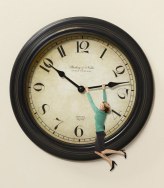
According to a recent and widely acclaimed behavioural study, one of the biggest killers of innovation in the corporate office is the effect known as “White Rabbit” disease. Once a business is infested with this potent virus, it quickly spreads, and is difficult to exterminate without the introduction of a brutal change management regime.

The “White Rabbit” disease gets its name from the fictional character in the book “Alice in Wonderland” (Lewis Carroll), where a large white rabbit is seen to be in a continual state of panic, whilst shouting the words “Oh dear! Oh dear! I shall be too late!”

Those employees exhibiting “White Rabbit” behaviour are easily identifiable. They will be the visibly stressed people rushing from meeting to meeting, always running late, and will be constantly letting you know just how busy they are with strong verbal flagellation sighs of self-importance.

If your organisation is deemed to have too many “White Rabbit” sufferers, and should an appropriate course of corrective action not be immediately implemented by a suitably qualified corporate physician, a stock market directive of absolute quarantine may be imposed. A short time later, a quick financial business vaporization will then prevail with irreversible effect.

But there is a simple and effective treatment that can be easily applied to those afflicted with the “White Rabbit” disease, and one which also acts as a long term inoculation for those that don’t yet exhibit any of the symptoms.

The treatment is called “time”. Not just any “time”, but “thinking time”, where the psychological stress and strain of those affected, who believe they have a need to rush in the corporate office, is eliminated from their daily ritual. The habitual application of “thinking time” leads to the development of a creative thought which tends to free the poor sufferer from all anxiety, which apparently has a direct causal link with the onset of “White Rabbit” disease.

Repeated applications of the treatment also appears to fortify the organization’s resistance to the affliction with lasting effect, as their employee’s ability to think creatively is reinforced, and in due course, may even lead to the encouraging signs of innovation.

So the answer is clear. When the first indications of “White Rabbit” disease become apparent, be swift with the copious application of “thinking time”, before it is too late!


Words Unspoken, But So Understood

ARTS010181

“Click” went the camera.

“That was a brilliant pose Janice! You looked fantastic with the bright light warming you as you stood in the doorway with your arms raised. Who would have believed that it’s the middle of winter here in Melbourne and it only stopped raining an hour ago”, said Henry Talbot (1960s Fashion Photographer*).

Janice laughed. “I hope you aren’t doing a close up as the large goose bumps on my arms would want a special credit in the photograph owing to their prominence!”

The photo was taken sometime between 1956 and 1961 and it had pride of place on the wall in my corporate office. The dated dialog between Janice and Henry was completely unknown to me; however, I just loved the look of the black and white photograph. Every time I saw Janice, I smiled as she provided me with a brief moment of inspiration that momentarily took me on a mental journey into a glamorous and unknown world that mingled with her past.

A thought then arose as I pondered her photograph.

Janice and Henry were in dialog when the image was taken; they were communicating and embellished the cultural mood of their time. The photograph was a snapshot in history that I, as the observer, brought to life in my mind approximately 60 years later. Other corporate colleagues visiting my office would also see Janice, yet their fabrication of her persona would indeed be different to mine.

So what if a photographer took an image of me sitting at my desk? How would observers view me in 60 years from now? Would they comment on my suit, my bow tie, my cuff links, or my corporate image?

No, I suspect none of these, but hopefully they would notice my smile. A smile that should be responding to a business culture that was innovative, creative and one that made me happy and content. Yes, a photograph does indeed tell a thousand words. The key is a want to listen.

Now for those HR Managers reading this blog post, take note. Why don’t you walk around your corporate office and surreptitiously shoot a candid, unprompted image of your employees. Look deep into the photograph and make sure that you analyse the true and honest feelings that your colleagues are portraying. Take a range of images over time and study the trend. The true answer will be in their smile.

I again looked up at the image of Janice and once again gave her a silent nod of appreciation. “Thanks Janice for your timeless and continual inspiration”.

Image: Fashion Illustration for Sportscraft, Model Janice Wakely, Photographer Henry Talbot

* http://www.ngv.vic.gov.au/ebooks/HenryTalbot/index.php?chapter=2

The Male V

6a00d8341c5b6153ef011570eacef6970b-300wi

What was the cause? The effect was indeed quite noticeable, and one that had been surreptitiously permeating the male physique for the past few years with minimal commentary from the more discerning female adult population who normally observe these things.

As I stood shamelessly in front of the hotel bathroom mirror whilst on a recent business trip with all but a white pristine bath towel encapsulating my lower half, I made a virtuous decision on behalf of corporate mankind to try and understand the origin of this visual perplexity. I looked at myself and realised that I, like many other men, was also not immune from this male condition.

Now before I proceed too far, you as an inquisitive reader might be wondering as to the potential side effects of this uniquely male malady, and more importantly, its impact on those that come into close male physical proximity. Firstly, relax, as the influence is positive and one that signals to the naked chest observer that the man beholden to this condition is highly innovative and a vigilant embellisher of a free thought.

The main visual clue is a sun-bleached v-shaped band of thick wavy chest hair that starts just below the male adult neck line and continues for a typical distance of about four inches in a downward direction. After extensive research utilising the detailed observation skills of many office based corporate female colleagues, a uniform and consistent visual theme started to emerge to which there can be no question, nor doubt of authenticity.

The chest follicular condition is believed to have first surfaced in the 1960s and 70s when many a business man elected to have a shirt dress code that was rather devoid of buttons. As the decades unfolded, men chose to portray a regressive and traditionally conservative closed shirt collar policy that supported a full neck length tie. However, over the past few years, men have discarded these formal fashion knotted links to the past and have gleefully accepted an open collared shirt prowess that has been readily approved by the business world as a sign confirming their creativity.

The consequence of this decisive fashion action has been exponential male chest hair freedom, a complete contrast to the historical times where they had been subjected to a barrage of restrictive shirt button protection and coverage. These empowered and unconstrained hairs are now able to reach their full bushy length potential and grow with unity in a v-shaped formation in solidarity with their DNA facial haired brothers.

So, should you, like me, no longer be a wearer of the business tie, may you flaunt your chest hairs in public with pride as you let all onlookers appreciate that you are doing your bit for the growth of innovation and creativity in the corporate office!

All it takes is a Jump

woman-flying-through-sky-side-view-1761303

I felt quite smug as I sat in the middle of my corporate nest as I delightedly acknowledged the numerous platitudes from my fellow bird siblings as they complimented me on my latest innovative feat. Yes, no other bird could match my skills in nest cleanliness and twig weaving; I was a bird who had no equal. I had spent all my working life perfecting my ability and I was the envy of all those in my nest.

However, with an unexpected rustle of feathers, my formidable life as I knew it changed forever as an older sister bird unexpectedly flew in from a distant tree. How she got there, I did not quite understand, but it took all of us nest bound birds by great surprise.

She cooed up to me with a confident waddle and greeted me with a beak expression that was definitely from out of this nest. I was in awe of her and needed to know more! She folded her broad colourful wings and together we sat perched in a quiet corner of the nest.

As we jointly partook of a nice fat juicy green worm, the dialog commenced and she told me of a life beyond the nest. I listened intently as she described an array of different branches, insects, water and other birds. My eyes, ears and feathers strained to comprehend the world that was being described to me. I had to experience it and asked her to show me the way.

My older sister smiled, and with a gentle melodious voice beckoned me to tail her to the edge of the nest. I immediately followed her with uncertainty and trepidation as fear tried to stop me from waddling to the top of the nest. But I refused to give in, I was now in “no birds land”, one foolish step and I would fall to the depths below.

Once again her calming melodious voice instructed me to open my virgin wings. I copied her wing movement, became totally petrified and shut my eyes as she instructed me with confident authority to “jump”.

I obeyed the instruction. A second later, as I saw the bottom of the forest rush up to me, I began to panic! But, after a short moment, my beady bird eyes suddenly saw the bright blue sky as an intense whooshing noise accompanied me as I reached unknown lofty heights. Wow, this is amazing as I looped the loop, and enthusiastically flapped as I glided around the forest with a new perspective on life.

Now, my dear reader, I’m sure that you can see the application of this feathery story in the corporate office. Yes, many employees look to within for innovation. However, the catalyst to creativity is achieved from experiences outside the “nest”. Sometimes, employees just need some encouragement to open their “wings” and “jump”.