
The Infectious Smile

Heike

Wow…..that was a great smile I told myself when receiving my coffee in the cafe! When this woman smiled, I, and everyone else she met just had to smile back. Her smile was genuine, natural, unforced and infectious.

This got me thinking….

How many people in your office “really smile”? Every business needs a “smiler” to initiate that human touch, to let people know that they are important and not just another employee number in the corporate organisation.

A “smiler” is like a little heat spot in the building that generates and radiates warmth that people are attracted to when needing a motivational uplift.

So why don’t we formalise the role of the “smiler” in the organisation chart? Those with the recognised “smiling skill” could list this attribute on their CV, and for those that are deemed “Masters of Smiling”, there would be a large salary increase entitlement to entice them to stay in the business! After all, these prized “smilers” would be the target of many a head-hunter (or smile-hunter)!

I also would suggest that each work department needs at least one accredited “smiler” to raise morale. For those working in the more dull work teams (eg accounting – apologies to any accountants that might be reading), a second “smiler” may be required!

So next time you see a person with a magnificent smile, please savour the moment and try to learn from the experience with the view of embellishing your own smile in the direction of “smiling grandness”!
 

Leading the Troops

9362723445_85b224a5a0_q

Never has the role of a leader been more critical than when an organisation is undergoing a severe dislocation derived from a Change Management program.

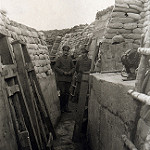
The impact on the business could possibly be likened to how a soldier’s behaviour changed when faced with trench warfare in the First World War. In the trenches the soldiers lived in constant fear of having to go over the trench wall to face a highly risky and unknown future. To an employee, the analogy is unfortunately very similar! Consider the following:

1. Casualties
The soldier was continually seeing many casualties inflicted on their comrades by the enemy (the employee experiences many of their co-workers being made redundant and lives in fear that they too may also lose their job)

2. Lack of Information
Most soldiers were kept in the dark regarding the military mission and only saw short term actions which appeared to be rather foolhardy (employees do not fully understand the end goal of the Change Management, but rather judge the progress being made by how it is impacting themselves and their immediate coworkers)

3. Rumours
A lack of regular communication and dispatches from the military command resulted in many rumours spreading amongst the troops (if there is a lack of communication from management, rumours become rife and spread quickly throughout the organisation leading to poor morale)

4. Environment
The living conditions in the trenches became intolerable and basic hygiene quickly deteriorated resulting in discontentment and potential mutiny (employees will cope with poor work conditions and uncertainty for a limited period of time, however, should this continue many employees will seek employment elsewhere).

5. Recognition
Those soldiers who exhibited extreme courage were awarded decorations of valour, such as the Victoria Cross (employee contribution should be recognised and rewarded).

The military commander needed to have the ability to inspire and motivate the troops to have the mental and physical fortitude to leave the perceived safety of the trench and to risk their lives to fight the enemy to gain a forward position.

Here the manager must also lead their fellow employees along the Change Management journey to ensure the success of the business reorganisation, otherwise the structural change process will undoubtedly fail. Employees need to believe that their individual contribution is significant and will make a purposeful contribution to the long term survival of the business.

So before you raise your “manager’s sword” and utter that famous “charge” command, make sure you have considered all the aspects associated with the life of a soldier struggling in the trenches so you taste victory instead of defeat in your Change Management activity!

Are You on the Bus?

Double decker bus - London

In many change management programs within business you would have heard the phrase…”Are You on the Bus”?

Let us explore this analogy a little further. Many of us when at school have experienced those bus excursions which were brilliant, and others that were a complete disaster. So what are some of the key elements that differentiated the two experiences?

The Good:
The Bus Driver was a great storyteller that engaged the passengers throughout the journey.
Your fellow passengers created their own excitement and fun.
The scenery from the bus windows were continually varied and made the view a delight to behold and appreciate.
Passengers moved around the bus to experience different perspectives on the journey.

The Bad:
The driver was an utter bore and provided zero inspiration.
The passengers did not interact, were silent and uninterested.
The view outside the bus was monotonous and made the passengers switch off because they were not engaged by the scenery.

So what are the learnings with the bus analogy for management?

The driver is critical! Managers need to have the ability to inspire and lead their employees along the change management journey so they are eager to participate in the activity.

It is important to motivate the co-workers who are already on the bus so they inspire their fellow passengers so nobody wants to get off.

Passenger comfort along the journey needs to be maintained. Here the manager needs to understand and appreciate how their employees are feeling emotionally and physically. If the temperature or mood is too hot or cold, it is the driver who is on control of the air conditioner and needs to make the required organizational climatic change.

However, there might be some passengers who really don’t like the journey. If so, just let them off at the appropriate bus stop otherwise they may become a negative influence on the other passengers.

The bus may hit a large pothole in the road and get a wheel puncture? If so, the bus should quickly stop and address the problem and take the required corrective action to ensure that a smooth ride continues along the route to the intended destination. There is no point limping along with a damaged bus as it will negatively affect the experience of all the passengers.

So when next you as the driver (and manager) are about to start your next bus journey of change management, make sure you consider the above and then jump into the driver’s seat, start the engine and put your foot down on the accelerator and go!


Trinkets of Status

Mr. Morgan Howard, Q. C., "Energetic Toryism"

Have you ever noticed that as you get more senior in an organisation, either professionally or academically, that the size of your “trinkets of status” increases correspondingly? For instance:

A PhD when graduating has a bright and very colourful hat that is bigger than those with a humble Bachelor’s degree.
A Judge has a sturdy and “not so impressive” wig and dominant gown that conveys their esteemed authority when in the court.
The CEO drives a flashy car that somehow always remains clean regardless of how many days they spend on their private farm roughing it in the dirt.

This got me thinking…..what if these trinkets of status were distributed on a random basis to those in their organisation even though they were not entitled to exhibit them?

Would those observing these new trinket recipients view them in a different light? I suspect so, initially at least in the short term. Those wearing the trinket may also momentarily take on the persona of the rightful trinket owner and demonstrate a higher level of performance and innovation?

So why not give it a go in your place of employment? The results could be rather interesting!?

There is of course one condition that needs to be imposed with respect to the CEO’s car. Before returning it, it does need to be clean, and should there be any speeding fines, the honorary trinket person is still personally responsible for the payment!


Timing your “pop” just right!

281/365 - pop the bubbly.

Consider the champagne bottle from an anticipation perspective and I think you will agree that it is a world recognised winner on all fronts! So what is the key to its success?

The Shape
It is an impressive design that is bold at the base and sleek at the top that commands a prestigious occupation position when situated on the shelf with less humble bottles.

The Wrapping
The combination of a sophisticated bottle label with a wired opening mechanism is an engineering masterpiece.

The Cork
The unleashing of this pressurised stopper announces the progression of a carbonised fluid stream of enticing drinking refreshment culminating in a distinctive and highly audible popping sound!

So, when the champagne bottle that is characterised by its shape, wrapping and cork, is introduced into any party or special occasion, it is always greeted with an air of rapture and excitement!

But once it is opened and all the contents have been consumed, the bottle is now viewed with a past sense of occasion and one now spent. It can only be popped once, so the moment is eagerly cherished by all beholders.

In the corporate environment we can learn a lot from the champagne bottle when making any strategic announcements as you only get one chance to get the impact of the “pop” just right! Get it wrong and your important message becomes a fizzle.

The key is to gradually build and promote the anticipation via a combination of carefully scheduled pre-positioning communication snippets so when the time is optimum, your message goes off with an impressive “pop” and is immediately appreciated by all employees.

So focus on the timing and make sure that you get that “pop”……just right!

Cheers!


The need for more noisy hot air!

Hot air Balloons

Yesterday, my early morning predawn walk of individual thought solitude was rudely interrupted by the sound of a large whooshing sound overhead!

On looking upwards, I sighted an impressive and colourful hot air balloon meandering through the clouds with a crew of delighted occupants peering over the edge of the basket gleefully looking down at me.

I became enthralled with the upward view as I listened to the random bursts of hot air blasts that the pilot used to reposition the balloon strategically in the sky. As the hot air balloon climbed to greater heights, I lost sight of it momentarily in between visual and audible “trackers” associated with the gas burner used to replenish the heated air.

The thought of these “trackers” I found interesting from a business perspective, particularly for those companies involved in the implementation of Change Management. During a time of structural change, employees need to have a reference point which reconfirms that progress is being made within the organization. In the case of the hot air balloon that was camouflaged within the clouds, these were the sounds and sights of the gas burner that punctuated its progress. In the business world, these “sight and sound trackers” could come in a variety of forms such as; financial targets, management forums, employee surveys, morale or via other external measures. The key is to have these “trackers”, and to promote them regularly as the Change Management “hot air balloon” travels towards the desired end goal (or “landing position”).

So for all you who are involved in piloting your Change Management process……make sure you make lots of noisy hot air!


To Bee or not to Bee?

Bee

I love looking at bees, they are just so busy flying from one flower to the next one in their quest for pollen. Bees have what I call true commitment to their job!

Our friend the bee doesn’t just focus on the pollen from one flower, but seeks out a variety of flowers to expand and complement its pollen supply. When the bee has sufficient pollen stocks, it buzzes back to the hive and willingly shares its collection booty with the total bee community. Here, other bees are allocated specific tasks to utilise and transform these collections to sustain and embellish current and future bee generations.

We can learn a lot from bees from a business and innovation perspective.

We too should follow the lead of the bee and seek ideas (“pollen”) from a variety of different sources. These can then be shared with our fellow co-workers whose job it is to then transform and work these ideas further into tangible and practical concepts to benefit the whole organisation.

The secret is to have many people generating these ideas, because once they start to dwindle, the long term survival of the total business (or community) is at risk.

So…..we need to get out amongst the corporate garden and “Buzz” with gusto!

Change Management – Coloured Breath Analysis

Sea Surface Temperature

It is common practice these days for an organisation to use various internal surveys or other methods of feedback to get an indication of the mood of their employees, particularly during a time of Change Management. These organisational pulse checks can be rather hit and miss as they are dependent upon the number of people who participate, and on the quality of the information that has been provided.

But….there could be a better way to accurately and instantaneously gain an understanding of employee sentiment via an innovative, yet to be invented process, called “coloured breath analysis”.

Consider the following……

If we could tag and classify a person’s emotional state in the office by measuring the “colour” of the air exhaled as they speak, this could be quite interesting. A “red” colour would signify that they were angry or agitated, “green” would indicate calmness, and “yellow” that they were neutral or somewhere in between the states of “red” and “green”.

Now, just imagine if these exhaled colour breath measurements could be plotted on an office location map, just like the synoptic weather map which indicates high and low barometric pressures? If so, this would provide an immediate, real-time measure of employee feeling that could be updated and reviewed on a continual basis.

Early warning signs of potential employee “cyclones”, or other impending “storms” that were brewing in the office would be readily identified so the appropriate corrective action could implemented in order to harmonise the corporate climate. It would also identify those more preferred “climatic” locations in the office which are more highly stable and have a calming influence on the surrounding areas.

Just a thought……but think of the possibilities if it existed!

Your Masterpiece Signature

June 2 2010 - Paint Brushes

I recently had the good fortune to visit an art exhibition highlighting the impressionist painting works of the master artist Monet. It was just awe inspiring how Monet worked with various paint colours which when viewed from a short distance looked like discrete paint brush strokes, however when observed from a few paces away, the colours merged to form a stunning homogenous landscape.

With this in mind, let us consider the vast and complex array of personal and professional skills, together with the unique attributes which we have developed during the various stages of our lives and working careers. These are like Monet’s individual colour brush strokes on the painter’s canvas. The masterpiece is created when they are merged and utilised creatively with that touch of innovation!

The opportunity to mix these individual “paint” skills is unlimited and they can be applied to numerous personal and business endeavours characterised with your own “painting signature”, just like those of Monet.

The key is not to focus on the detail, but to behold the bigger picture. After all, we are all priceless works of art!