If The Head Fits, Then Wear It

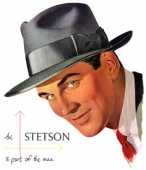
1950-mens-fedora-stetson-whippet

This afternoon I was standing nonchalantly at the corner of a busy road intersection painfully aware of the intense bright Australian sun beaming down on my hairless head with absolute ferocity. “Why was I not wearing a hat?” It was quite stupid really when I actually thought about, particularly when reminded by my delicate skinned head as it quickly transitioned to a pink coloured and progressively uncomfortable warm state.

Looking around at my fellow Melbourne city lunchtime walkers, I literally saw no hats adorning the head of any fashionable suit clad man, nor elegantly and spiffily dressed woman. The only hats observed seemed to be situated on the heads of the elderly, or those below the age of 20 in the shape of a mod-looking cap, complete with a market approved logo emblazoned just above its peak. In the years past, men and woman all wore hats that complemented and embellished their business attire, and which provided them with a distinctive look that was most dashing, sophisticated, and had that mark of business professionalism. So, why the change in our cultural hat appreciation? Was it due to the long, free flowing hairstyles of the sixties, seventies and eighties decades where the hair-boof factor made wearing a hat not socially acceptable, nor possible, owing to the excessive follicular volume?

One will never know, but the time is now ripe for a global corporate hat revolution!

Oui, Vive Le Chapeau!

My fellow corporate office compatriots, go on, don’t procrastinate any longer, take action, heed this call to your head and wear a hat!

I can hear your objections, one in particular, that being, what about the dreaded look of “hat hair”? Relax, all will be just fine, mainly as this newly acquired hair look will soon become a fashion statement that publicly notifies the world that you have elected to protect the longer term wellbeing of your head, and are now an accredited and chicly respected wearer of hats! Yes, you will be a modern trendsetter, and one that will soon be a stylish pioneer that will be ogled with extreme envy by the unfortunate hatless few.

Now, for any HR Managers reading this blog post, there is now one strategically important office furniture addition that you will quickly need to purchase to maintain employee morale, that being a hat stand so as to cope with the massive influx of hats!

The Theory of Toe-Show

70683e3bb39ed3da268d3b4419dcfc11

There is a little known, yet so very powerful, antique humanistic theory that is the key foundation in the development of creativity in the corporate office.

This theory has been in existence since the time of primitive man, reached its peak during the ancient Greek and Roman eras, and then regrettably, rapidly diminished with the advent of a more mobilised lifestyle and technology. Fortunately, we have all experienced momentary glimpses of its glory when we are imbibed in our unprotected casual or social interactive home state, but it is rarely seen in its natural physical form in the business environment.

For those exclusive individuals that are in the know, it is called the Theory of Toe-Show. Yes, this important theory relates to your feet, more precisely, your naked feet, unprotected by socks, stockings or shoes, but fully bare to the eyes of the world.

As you ponder the machinations of the Theory of Toe-Show, try and visualise yourself arriving home from the corporate office after a long, hard mind-draining day. What is the first thing that you do to alleviate and rectify your highly-strung mental state? Yes, you take your shoes off and introduce your poor bound feet to a world of nakedness and comfort, and typically exclaim an audible sigh of relief at the attainment of extreme personal satisfaction. Your mind quickly appreciates this mental toe showing and immediately responds with an unhindered release of creative thoughts that would never be aired in your corporate state of status quo.

Prior to the advent of shoes, our feet enjoyed a fully naked status as they were gleefully exposed to the full ambience of their geographic surroundings. The Theory of Toe-Show states that there is a direct link between your feet and your innate creativity. The more you cover your feet with shoes (and such-like), the more your mind is masked from the innovative sparks of your native imagination.

Think of the great Greek and Roman philosophers, their military leaders, their extraordinary astronomers, and their other leading and memorable personas. The origin of this creativity was indeed their minimalistic footwear. Yes, they wore sandals, or just wandered around quite content in bare footed bliss, fully aware that this was the source of their creative intelligence.

So next time you are trying to develop a culture of creativity and innovation in your corporate office, the answer is simple. All you need to do is to implement the Theory of Toe-Show and leave your shoes at the office door and many ideas (and potentially some odours) will quickly prevail.


The Mesmeric Corporate Prognosis

hypnotist

My esteemed colleagues, yes, I can sense your excitement and anticipation! But please relax as you need not wait any longer! After years of pain staking personal research sitting in the entrance foyers of the top 100 global companies, I am now pleased to announce that I have discovered the origins of this incapacitating corporate behavioural phenomenon.

This crippling condition that has inhibited the innovative thinking processes of employees for many decades, now has a medical name, that being “Corporate Mesmeric Innovative Retardation”, or CMIR for short. But more importantly, there is an antidote that is quite painless, and one that can be quickly administered to the corporate employee with immediate effect.

How did I discover this condition? Well, the intensive research required a high level of painstaking incognito behaviour on my behalf involving the wearing a beige nondescript suit, together with countless hours reading The Times, The Wall Street Journal and other local newspapers so as to not be noticed by the employees as they entered the corporate office. Unfortunately, I am still scared by the lack of fashion colour and style, but it was a burden that I was willing to bare for the sake of worldly corporate progress, I’m told the nightmares will eventually subside. The upside, is that my knowledge of world affairs, including the stock market, has resulted in various personal financial gains derived from highly profitable share trading, and a vast array of exclusive invitations to attend numerous London and New York high society trivia quizzes where I am deemed the font of all knowledge, and a most prized team member.

So what did the extensive research tell me? Although my study will be printed in next month’s edition of the Harvard Business Review, I’m sure that the HBR Publisher won’t mind me providing you all with a brief overview of my findings.

They key aspect to my world breaking research was the use of eagled-eyed observation. After countless detailed and personally exhaustive people watching experiences, I noticed the behaviour of all employees (particularly the attractive ones) as they entered the corporate office first thing in the morning, and then as they left that evening. The behavioural change in those inflicted employees at some businesses was profound, it was almost as if I was looking at two different people! Prior to them walking into the corporate reception area, they had a happy persona and exhibited all the normal signs of chirpiness, a willingness of thought, and a noticeable desire to learn. But once their foot stepped onto the marble tiled entrance foyer, it was as if an invisible intensely powerful force quickly sucked all the creativity from them, to which an innovative void remained until they departed the building at 5 PM sharp. At 5:01 PM, their creative vacuum was immediately replaced with their original pre-work positive behaviour. Yes, it was truly remarkable observation to behold!

Although quite mystifying, not all corporate businesses had employees that suffered from the dreaded CMIR condition. To understand the cause as to why this unexplained phenomenon may have occurred, I had to dig deeper into the observational evidence and decided to introduce the HR Managers of the companies studied into the rich complexity, and subtle machinations, of my academic research. After numerous soy milk chai lattes, and what seemed like an endless consumption of gluten-free bagels, I came to a momentous and decisive eureka moment. Apparently, the culture of the organization had a direct correlation with the onset of the CMIR. Should the culture be viewed negatively, then a high frequency of CMIR suffers prevailed. The trigger for most employees who had acute CMIR was the initial sighting of the company logo, typically first seen when they entered the company premises in the morning.  On viewing the logo, a negative and mesmeric effect immediately struck down the creatively-fragile employee resulting in a mind destroying innovation purge, luckily this was a reversible retardation that quickly ceased when exiting the building at 5 PM.

Yes, you are correct in assuming that those companies that had a positive and dynamic corporate culture that was well respected, and one that harmoniously and gleefully fitted with the employee’s lifestyle goals, experienced no CMIR sufferers. So the answer is simple. To eradicate any corrosive and long-term damaging CMIR influences in your business, management do need to focus on the right corporate culture to ensure that their business logo immediately inspires your employees when first sighted as they enter your office.

And should you need any assistance in the process, my consulting fees are indeed negotiable (but please, no gluten free bagels).

When a Building Thinks

13948288967_646b2078bb_o

According to the erection date chiselled into my cornerstone, I’m a middle aged corporate building as measured by employee years. However, as all the other offices around me keep telling me, with age, comes experience, and I have seen it all.

My occupants come and go, make noise during the daylight hours, but thankfully they let me rest during the night which allows me time to recuperate and get my office back in order with the assistance of what they call “cleaners”.

Like all thinking entities, as I get older, I do start to lose a few fibres from my carpets, the walls and fixtures take on a slightly more shabby look, and there is the occasional random odour from the basement, but a regular make-over seems to do the trick which helps me look decades younger. The key to my youthful appearance is in having a well defined, and rigid inspection regime, where a realm of specialist tradespeople annually check me over and make sure my inners are operating efficiently. If not, a non-working item is quickly identified, rooted out and professionally replaced with something more modern. Any discomfort, or embarrassment that I may experience during this operation as my private rooms are exposed to all observers, is quickly forgotten when I consider the longer-term benefits.

As I’m more “buildingly” mature, I also have the ability to be the master of my occupant destiny, a trait many younger buildings can only aspire to, and one that I’m regularly quizzed about. For those of you that have read my many interviews in the Harvard Building Review (HBR), I won’t repeat the details here so as not to sound too pompous, nor repetitive. But for those that haven’t, the key is in using your inherent building skills to manipulate those within you. For example, should I experience an internal people upset that needs to be purged, I evoke my fire sprinkler system to remedy and dampen down the origin of the disturbance. Another option is to deliberately rest a people section of my building structure by strategically removing the power supply from the offending area. For those occasions that need a rapid solution, nothings beats the immediacy of a broken sewer pipe or gas leak which seems to work every time! But as a word of caution, don’t use this last one too often, otherwise you may find yourself being served with an official building condemnation notice which can cut short your life expectancy quite quickly.

Like all buildings, there will come a time when I’m no longer appreciated and I will be asked to make way for something an architect deems younger, more fashionable and environmentally friendlier. No, I’m not perturbed, because I know that I will be reincarnated once again into yet another building as my structural DNA is recycled and used as foundation rubble fill, thereby continuing my thought, and influence, in the corporate office.


I Am Your Idea

Euphoria

As an idea, I was quite happily resting in an unassuming nerve-end in a remote corner of the brain of my original owner. It was quite a good life really, just sitting back taking it easy where I was oblivious to all the busyness of those other ideas around me. But then, my life changed, and in a phenomenally big way!

For some unexplained reason, my owner’s brain decided to think. Why this happened, I have no rhyme or reason as to what initiated this mental activity, but the result for me was an electric and significantly life changing experience. Once the process of thinking commenced, I started to notice an immediate change in my appearance. Yes, I started to transform into a larger and more complex idea. I quickly gained substance, and in a most surprising and totally unexpected way, my social life increased exponentially as I became really popular with other ideas that were totally unknown to me. It seemed like all my new idea acquaintances wanted a piece of my being, so much so that I started to lose my individual identity.

As the concept of human time mysteriously progressed in what seemed like only microseconds, the idea of me started to reside in not just my owner’s brain, but also in that of many people. This biological effect continued to compound and I was swiftly transported via numerous communication methods across the globe into other countries, cultures and out into the solar system and beyond.

I started life as a single idea, but now I am a thought celebrity and one that is core to the survival of many other ideas and foundations of knowledge. Owing to my immense popularity of thought, I am now frequently mobbed by many other small and less advanced ideas, all seeking my autograph where they try and absorb any readily accessible part of me as they themselves quickly grow and develop.

I’m now unstoppable, viral and as long as there is a mind that can reason and think, I will exist. I am thought personified as creativity and innovation. I am your idea.

Framing Your Office Correctly

Paris & London 2011 922

When walking around an art gallery you will see a variety of different people mulling in front of an oil painting making all kinds of comments. Each of them will see different aspects of the painting and will make their own interpretation as to the artistic and messaging intentions of the painter.

Some observers will focus on colour, the scene portrayed, or potentially the interaction of the people encapsulated in the work of art, and what they may be thinking or experiencing.

The viewer’s analysis of the painting will be varied, with each opinion based on their own unique life experiences that have coloured their thoughts and imagery on life.

This got me thinking. What if you took a random, non-staged photograph of the workers in your office that captured a specific moment in their working day? This image could be black and white, or coloured, placed in an impressive frame and then hung on a wall, just like in an art gallery.

So as to avoid any potential bias and insider people knowledge, employees from a non-related business would then be asked to comment as to photographer’s intentions, just like the painter of the oil canvas.

Those observing would come up with a range of assumptions and theories, some of which could be related to the work culture, stress, mood, or happiness of those people contained within the “frame”.

The collective feedback would provide a unique and objective insight into the machinations of your office. However, in this instance, the painter, or photographer, is your CEO, as this role is the creative source of the scene. Depending on the critical comments received, is your CEO proud to sign their name in the bottom right corner of the painting to stamp their ownership of the work? If not, maybe they would prefer to learn from the feedback and use it to develop and fine-tune their management artistry skills and have another go?

Yes, a picture does indeed say a thousand words. The key is to listen to them.

Free your Hairs

Woman holding hair

I am indeed honoured to receive the 2015 Nobel Prize for Science!

I’m particularly pleased that my academic peers, and the international science community, have now finally accepted my many years of extensive research into hair receptivity and now recognise it as a credible scientific theory into innovative psychology.

Yes, we can now prove without a “reasonable” doubt that there is indeed a direct causal link between an individual’s hair and their ability to think creatively.

It appears that woman throughout the ages have inherently understood this little known fact which is exemplified by their willingness to have long, free flowing hair. Men, on the other hand, have considerably disadvantaged themselves creatively via an interest in having that clean shaven look (face and head), and their hair far too short. To exacerbate the male problem, those with a hairy chest, and those lucky enough to have a hairy back, have hidden their follicle prowess under garments (see the blog post titled “Membership in the League of Hairy Chested Men”) [1]. Age should also no longer be a reason for eliminating bushy eyebrows, hairs permeating in your ears and other less spoken about facial areas.

Thankfully, our proven research will now change this archaic hair behaviour for good.

This ground-breaking research indicates that the volume of hair, regardless of where it is located on the body, acts as a transmitter of creative thoughts, the more hair, the increased ability of the individual to think imaginatively. Yes, this theory does indeed explain the innovation behavioural problem evidenced in cyclists who shave their legs, and swimmers who like that total all over body nude look, specifically high platform divers.

For all you HR Managers reading this blog post, the key to creating a culture of innovation in the corporate office is for your employees to be encouraged to have long hair (both men and women) and for men to grow beards and moustaches. Now for those men fortunate enough to have a hairy chest, yes, the choice is obvious; all business shirts should have no buttons.

Yes, there is one casualty with this research and this relates to the activities of the hairdresser. Demand for haircuts will indeed decrease, yet hair styling will remain constant, so should you be thinking about a career in this field of employment, you have been warned.

In summary, be hairy and let your innovation grow to the fullest.

[1] https://thinkingfuturethoughts.wordpress.com/2015/03/30/membership-in-the-league-of-hairy-chested-men/

Fully Equipped by Q

M4DGOLD EC004

I was rather chuffed, I had just received my “00” status and was now fully licensed and about to start my first assignment.

As is customary, all “00” agents had the obligatory visit to the office of Q to get fully equipped for the task at hand to ensure a successful mission. On talking with my mentor, James, I was rather excited about what tools of the trade the famous Q would provide me for my first business encounter.

As I walked down the bleak office corridor that typified MI6, my mind wondered about what tools I would receive. Would it be a Walther PPK, a Geiger counter watch, tear gas cartridge disguised as talcum powder, or maybe a bagpipe with hidden machine gun? I didn’t really care I must admit, I just wanted to start my first mission which was to infiltrate a corporate office with my assigned identity as Global Marketing Director.

I nervously knocked on Q’s office door and a female voice invited me in. Once inside, I quickly discovered that this was no office, this was a room full of an overabundance of gadgets, some I recognised, some I had no clue as to their use.

Q, was not what I expected. She was a redheaded woman, I suspected in her early thirties, dressed impeccably in the latest business attire with a smile that made you melt when you first met her. Q had me at “hello”.

Q enquired as to my mission to which I provided the requisite details in rather a tedious and long-winded verbose manner. Q smiled and cut my conversation short and said, “Say no more, I know exactly what you will need”, to which I sighed in rather a too loud a manner for a “00” agent. After all, we are elite professionals tasked with one objective that can be brutal, callous and potentially dangerous.

Q walked to a large cupboard, did a retina scan security check and immediately the cupboard door opened. Q reached in and pulled out a large clear glass bottle with a cork strategically placed as a stopper. Q then handed it to me and stated that this is all that I needed for my first mission. I picked it up, shook it, peered into it and asked whether it contained nerve gas or whether the glass was an explosive?

Q then explained the power of the corked bottle. “As you are going to work in a corporate office, the only tool you will require is what’s inside the bottle and you can open it any time you like, here, now, or when you are strategically positioned at your allocated place of work”.

I couldn’t resist, I decided to pop the cork and see what awaited me. I did so and encountered no gas, no odour, no bang, just, nothing. I glanced at Q with an inquisitive look.

Before I could ask my question, Q advised; “You don’t need any gadgets, you just need to allow yourself to be creative, to let your mind go, just like the gas inside that bottle has now done. This is the key to any marketing and innovation role. Many people think they need tools to stimulate their creativity, such as brainstorming sessions, external stimuli, etc, but what they really need to do is to just think that little bit differently. It’s quite simple really, this isn’t rocket science”.

I thanked Q for the corked bottle and slowly walked out of her office ready to commence my mission, but stopped and said, “But surely as a “00” I should at least have a Walther PPK?” Q replied, “You have a creative mind, that is much more powerful and deadly, trust me”. And I did.

Dream Communications

Untitled

Sometimes it’s difficult to tell whether you are dreaming, or actually in a dream. In this instance, it was not a dream, I was wide awake and fully conscious.

My doubt about dream authenticity started yesterday when I was looking at the young woman sitting opposite me in the coffee shop. I was thinking thoughts, and she seemed to respond ‘verbally’, but there were no words or facial expressions exchanged. Yes, we were communicating, having a conversation that only we were privy to, well, I thought we were, or was it my imagination? So I decided to test the theory and commenced an unspoken thought conversation of triviality about the benefits and negatives of colonising the moon with soy milk chai latte drinkers! After a few minutes of what seemed ‘mindless dialogue’, she stood up from her comfortable cafe seat, straightened her skirt, flicked her long blond hair back and smiled directly at me. She then to my surprise said, “Chai lattes do need honey, but are there bees on the moon?” She then handed me her business card and suggested that we ‘chat again’! Yep, I had my proof!

Now this might have also been a dream, but let’s not worry about the semantics of truth as the concept gave me an idea for the corporate office.

What if we could train ourselves to dream, but in a way that we communicate with colleagues on a particular topic that needs to be resolved or progressed, but only in our subconscious mind? The workplace and the people concerned could be role played in our thought whilst we slept?

Taking the concept further, what if you could ‘suggest’ an issue that your colleagues could also ponder and work on in their minds whilst they also slept?

Now for the interesting and really exciting next step, what if we could get your mind, and the minds of your colleagues sharing the identical dream at the same time, exchanging learnings and experiences? Following on from that idea, why not add other people that you don’t yet know from different companies, cultures or countries, into the dream for an exponential group thought enhancement experience?

Those readers in HR will I’m sure now be realising the training and innovation development opportunities, particularly from a regional or global perspective?

For those of you struggling with all of the above, may I suggest you go into a coffee shop and order a soy milk chai latte (with honey) and just let your thinking go with the flow. And, should a blond woman appear to respond to one of your thoughts whilst you quietly sip your drink, just mention this blog post and I’m sure you will be surprised by the response!

What does your bowl say about you?

Day 96 - Thinking about it...

As usual, I arrived in our corporate office early and made that all too familiar journey of walk into our club lounge where the ingredients of a basic breakfast awaited me. There was the usual array of cereal, muesli, fruit, whole milk, light milk, the obligatory soy milk, and of course coffee and a plethora of teas.

But this morning, something was noticeably different. Rather than being confronted with the usual food branding, some clever and rather innovative colleague had labeled each item with a unique and curiously descriptive name. There was also a page of instructions that each breakfast eater had to follow, otherwise they would be excluded from this unique eating activity.

The first instruction was to grab a white bowl and mug from the cupboard and scribe my name on it with the black marker pen provided. However, rather than just spelling my name, I had to add the words “personality” after it. As such, my bowl and mug were named “Steven’s personality”.

I was then asked to peruse the array of cereals which were now labelled as ‘creative’ (aka muesli), ‘conservative’ (aka corn flakes), ‘fun’ (aka Coco Pops), ‘vitality’ (aka porridge). What looked like full cream milk was called ‘communication”, light milk (‘vision’) and soy milk (‘humour’). The process continued for all the fruit and beverage selections to which other descriptive tags were applied.

Once my food and beverage selection had been made, I was then requested by the instructions to write these pseudonyms on the bowl and the mug which was to be a reminder of personality for that day.

Although the process sounded like a bit of fun, after a week of breakfast personality profiling, there were some interesting learnings from the activity:

1. You are what you eat.
2. We can be so set in our ways which, we may not see until you observe the same food and beverage personality pseudonyms written in black pen on our bowl and mug each day.
3. Change is not as hard as you think, just reach out and try something new (eg different cereal, fruit, milk). If you don’t like the ‘taste’ of it, well, learn from the experience and explore something that is more suited to your palate.
4. Variety is indeed the spice of life.

My personality, well, I’m quite content with a bowl of Fruit Loops, yes, say no more!