The Office Well-Being Executive Manager

RetroWoman1950sStyle-Attrib-Flickr-MipsyRetro-5593568015-640x604

The corridors of corporate life used to experience it at least once a day, typically around 3 PM. Those of you with a longer memory say it also occurred in the morning, but alas, those days are reluctantly gone, possibly, never to be repeated.

The eagerly awaited activity heralded an opportunity to have a short break from your normal work routine and to refresh your mind with small morsels of needed sustenance.

It was a welcome time for all pens to be lowered, inky nibs blotted, and writing paper pushed aside on your desk to make room for the appreciated earthenware additions.

For a brief few minutes, the worker could engage in a pseudo-flirtatious social dialogue and build a non-threatening personal rapport with the service provider, who was usually wearing a bland coloured corporate pinafore apron. Their official work title was “Tea Lady”, but they were the backbone of many successful organizations.

No office door was ever closed to the Tea Lady. They traversed the building pulling a trolley that was equipped with a large teapot, hot water, coffee, milk, a selection of biscuits (or cakes if you were lucky), and an array of cups and saucers, some of which occasionally matched. Their arrival could be heard well before they reached your desk, owing to the rattling of the crockery and the heightened conversation that they would always generate.

The role of Tea Lady was an unrecognized strategic cog in the corporate organizational hierarchy as they were privy to all levels of the business, from senior management, right down to the new starter or graduate. They could sense the mood of the corporate office, whether it was dynamic and innovative, or one that was struggling and ready to implode. The Tea Lady became the confidant of many employees, a person that they could talk to about work, home-life or their personal ambitions.

Business today needs a modern version of the Tea Lady, which would probably now have the more acceptable corporate title of “Office Well-Being Manager”. Many organizations have tried to foster various methods of casual communication within the corporate office with the introduction of “Chatter”, “Yammer” and other electronic applications, but none have been as effective as the old fashioned Tea Lady.

So why not reinvigorate the Tea Lady role with a more modern version?

Many employees want to have access to their senior management team, but may be too shy or a tad embarrassed to engage them in an open forum. One solution is to have a weekly (or monthly) roster where your Executive Team takes it in turns to be “Office Well-Being Executive Manager”. Yes, they would walk the office corridors with an electric powered beverage trolley fully equipped with the latest coffee (short black, long black, latte, cappuccino, flat white), tea (Early Grey, English Breakfast, Irish Breakfast, herbal), soymilk chai lattes, and a selection of cakes (high fat, low fat, gluten free) or fruit. Besides your Executive Team learning new catering skills that they can add to their already impressive CVs, they would have instantaneous access to the pulse of the business and an opportunity to gain an insight on the nuances of their staff (and vice-versa).

So, when next you plan to have a well-earned rest break from your computer, may I suggest that you first stop, and listen. Hopefully you will hear the buzz of your corporately branded electric beverage trolley as it happily approaches your desk. Bon appetite!

Caputignis: Business Greatness

paul-lasalle-my-favorite-martian-by-conceptguy-d5lqdzw

What makes a good company great? Forget looking to the traditional sources of business, academia and other highly paid consultants for a complex answer as the solution is deceptively simple.

After years of tireless observation in the corporate office, the source of company greatness was found to wholly reside in the “caputignis” level of the organization. Those with a classical education grounded firmly in Latin will know exactly what this word means, that being “head sparkification” (caput = head, ignis = spark).

The classification of “great” can be readily substituted with “innovation”, as a great company is one that is immediately known for its phenomenal ingenuity and corresponding business success in the marketplace.

Caputignis is thought to be an emotional energy state that is generated when the employee has a spark of creativity. However, unless this fleeting moment of inspiration is rapidly captured and harnessed within the corporate office, it will quickly vanish and will be permanently extinguished by a conservative organizational culture. For those unfortunate companies where this occurs, their caputignis levels were found to be very low.

Now for those businesses that were deemed by the financial market to be great, their caputignis levels were recorded as being extremely high, continuous and homogenous in all their work activities. The culture of these companies was publicly and internally acknowledged as being highly innovative, and almost electrifying in its nature, so much so that any creative sparks generated by individuals, or work teams, were instantaneously conducted throughout the organization. Here the employees as a collective, worked and shared ideas thereby generating a highly reactive caputignis flux that stimulated and encouraged innovation, together with an overflowing plethora of new thoughts.

Do you need to purchase an expensive caputignis measuring device to see where your organization sits on the greatness level? No, there is a more cost effective approach, that being the vibe that your employees feel when they are in the corporate office. If they are continually bubbling with new mind-sets, and end the working day with a feeling of excitement, then your caputignis level is high. Alternatively, if your organization struggles with the generation of innovative ideas, then you need to work on establishing an employee culture that stimulates head sparkification.

So what makes a good company great? Caputignis.

A.E’s Forgotten Law of Innovation

Einstein Diary

The diary page was dated 14 June 1933. The blue ink handwriting, although quite faded, was still legible and was written in the old Germanic letter style of my grandfather.

Later in life, he did indeed become quite famous, in part due to his outlandish and peculiar hairstyle, but it was curious how this small piece of creative research never obtained the public notoriety, like all his other hypotheses?

As I rummaged respectfully through the following well read diary pages, it became apparent that quite a few foreign governments were also interested in this unknown research that suggested a somewhat fool proof theoretical methodology on the Law of Innovation. As he was Jewish, I wasn’t surprised that he elected to leave Germany and continue his innovation work at Princeton University in the USA.

But why was his theory on the Law of Innovation never published? I chuckled after reading a few more paragraphs as the references to the CIA may have had something to do with it?

But there it was; one paragraph was underlined repeatedly. In the page margin were his initials (A.E.) that he only used when he had exhaustedly confirmed that a Law had been proven.

As I had the esteemed position of Professor of Thought Creation at a reputable and well-known British University, I read the paragraphs on the Law of Innovation with interest.

Quote: “The Law of Innovation: Innovative thoughts are created when the thinker deliberately places their mind simultaneously in a multitude of time periods whilst still being in the present”.  

I had to read this paragraph twice and then I finally understood the concept. When solving a problem, the thinker needs to look at the issue from a range of different time perspectives, some of which may be unknown to you. The concept of time forces the individual to indeed think differently. For instance, if the year was 1930, how would the problem be solved using the resources of that time period? If the year were now 2100, a different set of solutions would prevail. Now bring the future and past time-dated solutions back to the present and look for any common themes and similarities. As you think with an open mind, an unexpected innovative thought will eventuate.

So for those readers of this blog post that work in the corporate office, may I suggest that you invoke the Law of Innovation and I’m sure that with time a creative solution will be revealed.

Umbrellas, Be Gone with Them!

singing in rain

It’s a most awkward feeling, and you’ve all experienced it, particularly when you encounter someone of approximately the same height. There is a momentary sigh of slight relief when the oncoming individual is deemed to be shorter or taller, the larger the difference the better, until it is quickly replaced by the mandatory manoeuvring so as to avoid any unwelcome impact.

The unavoidable cause of this precipitous, and most stressful combative environment is rain, and its presence signals the use of the antiqued protection item called the umbrella. It doesn’t matter how hard or soft the rain may be, as soon as it falls from the sky, an array of umbrellas hurriedly appears and pedestrian life on the footpath becomes mayhem.

If there were a standard sized umbrella that just provided sufficient circumferential rain protection tailored to the average individual walker, this would greatly assist with commuter meander flow. But no, some undisciplined selfish people elect to brandish a massive brightly coloured golf umbrella, designed for maximum rainfall protection, that produces a pedestrian bottleneck wherever they walk.

There must be a better system of rain head protection, and I’m pleased to say that there is, and it’s called the Aerocap™.

After countless hours of creative thinking time, the Aerocap™ is now fully functional and ready for its inaugural market launch. Its design is simple, yet so effective. It has been fashionably styled by a famous Melbourne designer (who for some reason wants to remain anonymous), and can be purchased in an array of distinctive colours, fabrics and sizes to accommodate all heads.

So how does the Aerocap™ work you may ask? Well, let me educate you.

This innovative rain protection device comes with easy to follow instructions that are listed below:

  1. Place the Aerocap™ on your head.
  2. At the first sign of rain, gently press the carefully camouflaged “start button” that is situated just under the front cap peak.
    (Note 1: for the football team beanie version, press the big pompom. Note 2: for the beret version, press the stalk).
  3. Once the “start button” has been pressed, the top of your Aerocap™ will spontaneously open and an incredibly quiet high intensity airflow will be initiated in an upwards circular direction.
    (Note: You may feel as if you are being pushed with a downward momentum, but this is normal)
  4. Any rain will now be forcefully projected away from the Aerocap™ by the airflow keeping the wearer dry and happy.
  5. Throw away your umbrella, as you won’t need it any longer!

Disclaimer: The Aerocap™ is powered by a small amount of uranium. But don’t be alarmed, as keeping your head dry in the short term was deemed by the now deceased test user as being much more important than any long term radiation concerns).

There is another benefit with the Aerocap™ (not mentioned in the instructions) and that’s the impact it has on those recalcitrant pedestrians that still selfishly carry those large imposing golf umbrellas.

When the Aerocap™ wearer walks under one of these grossly flamboyant umbrellas, there is a detection sensor that quickly increases the air velocity that may result in the umbrella holder suddenly being projected 20 feet in the air. But don’t be too concerned, as by the time they land on the ground with a thump, you will be well gone and will not hear their verbal outbursts.

So how do you get an Aerocap™?

Any classy and sophisticated hatter will sell them. If not, just mention the brand name Aerocap™ to the sales person, and I’m sure you will be given an appropriate response.

Green Rolls and Hands? Nope!

11748752006_c8f81865c9_o

For those of you that notice things, you will have seen this overt activity as it nonchalantly happens at precisely the same time every work day, typically around 12 PM.

The routine has been slowly increasing in acceptance and is now seen gastronomically throughout the global corporate lunching fraternity. The more worrying part with this viral consumptive eating trend is that it has been gradually eroding the employee’s ability to be creative with each unassuming, yet decisive, bite.

Other visual clues to this habitual eating disorder are the sporadic green flakes, annoyingly wedged firmly between the consumer’s front teeth, that unfortunately quickly diminish the potency of any beneficial smile that may have permeated from the nominated cuisine experience.

Owing to the well marketed hand-held appeal and versatility of this unique luncheon product, your corporate colleagues will recklessly chomp on it without any personal welfare concern as they freely walk, engage in other physical exercise, or whilst happily sitting in a relaxed stationary position at their work desks.

Yes, I’m talking about sushi!

Unfortunately, this repeated daily eating sushi experience has markedly diminished their innovation skills as they no longer use their sensory exploration nous to seek out other equally satisfying food alternatives. After years of reckless sushi eating, this innovation retardation can be readily validated via the application of any up to date Myers Briggs personality profiling where comparisons can be easily made to when they didn’t have this eating disorder, and when their taste buds enjoyed a diverse choice in luncheon opportunities.

So the answer is clear. If you want to quickly increase innovation in your corporate office, urgently circulate an official HR decree than bans the eating of sushi with immediate effect.  Your business, your work colleagues, and the other non-sushi selling establishments in your office area, will thank you greatly.

The Answer to that Male Question

Shaving

There is “a question” that has been baffling mankind for centuries, and as “the answer” was unknown, professional men all around the world reluctantly decided to play it safe, just in case they got it wrong. That is, until now!

As I sat in private solace in the world-renowned Corporate Observation Research Zone (aka the Virgin Australia Lounge at Melbourne airport), after many minutes watching my fellow travelling compatriots, the clues to “the answer” slowly became apparent.

The attraction of the Virgin Australia Lounge is the diversity of corporate inhabitants that provide a huge array of visual observation fodder. There are men of all ages, some wearing suits, others casually dressed. Some with hair purposefully positioned on their face and heads, some with a deliberate close shaved facial nudified look, even those with an upper head appearance that conforms to their hairless heredity.

“The answer” to “the question” is that it doesn’t matter where your draw that “line of separation”.

Yes, men from the time they first decided to shave have been in a quandary as to where to position that mysterious demarcation line that signifies the end of the side-burn. To make matters even more confusing, should the man be fortunate enough to have a headless head, and has a beard, where should the top of the side-burn commence?

The author of this blog post is pleased to advise that men’s side-burn fashion has now progressed to the point where no facial rules apply. Men are now exercising their innovative side-burn freedom and are letting their razors do the talking without any limitation, or fear of visual retribution.

So men, next time you are confronted with a decision as where to “draw the line of separation”, relax, the choice is indeed yours. And should you make a mistake, all is good, as the hairy, or hairless, problem will be rectified in due course by the planned arrival of the following morning, when next you look in the mirror equipped with your trusty razor.

“White Rabbit” Behaviour

55090611e4ef2-0112-woman-hanging-on-clock-xl

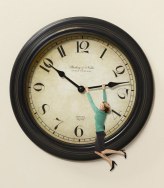
According to a recent and widely acclaimed behavioural study, one of the biggest killers of innovation in the corporate office is the effect known as “White Rabbit” disease. Once a business is infested with this potent virus, it quickly spreads, and is difficult to exterminate without the introduction of a brutal change management regime.

The “White Rabbit” disease gets its name from the fictional character in the book “Alice in Wonderland” (Lewis Carroll), where a large white rabbit is seen to be in a continual state of panic, whilst shouting the words “Oh dear! Oh dear! I shall be too late!”

Those employees exhibiting “White Rabbit” behaviour are easily identifiable. They will be the visibly stressed people rushing from meeting to meeting, always running late, and will be constantly letting you know just how busy they are with strong verbal flagellation sighs of self-importance.

If your organisation is deemed to have too many “White Rabbit” sufferers, and should an appropriate course of corrective action not be immediately implemented by a suitably qualified corporate physician, a stock market directive of absolute quarantine may be imposed. A short time later, a quick financial business vaporization will then prevail with irreversible effect.

But there is a simple and effective treatment that can be easily applied to those afflicted with the “White Rabbit” disease, and one which also acts as a long term inoculation for those that don’t yet exhibit any of the symptoms.

The treatment is called “time”. Not just any “time”, but “thinking time”, where the psychological stress and strain of those affected, who believe they have a need to rush in the corporate office, is eliminated from their daily ritual. The habitual application of “thinking time” leads to the development of a creative thought which tends to free the poor sufferer from all anxiety, which apparently has a direct causal link with the onset of “White Rabbit” disease.

Repeated applications of the treatment also appears to fortify the organization’s resistance to the affliction with lasting effect, as their employee’s ability to think creatively is reinforced, and in due course, may even lead to the encouraging signs of innovation.

So the answer is clear. When the first indications of “White Rabbit” disease become apparent, be swift with the copious application of “thinking time”, before it is too late!


Read My Lips

Jumbo Mumbo Doll

“Read my lips”, was the instruction.

As always, my earplugs were deeply inserted into my ear canals as I tried to block out the unwelcome background noise on my early morning Virgin Australia flight from Melbourne to Sydney.

The air-hostess, dressed impeccably in her swish fashionably styled Virgin Australia uniform was making an announcement on the PA. I heard not a word, but I understood everything that she said. Yes, I was reading her lips.

A few minutes later, I pondered why? Then it dawned on me. It was her intensely bright red lipstick. Yes, I was fixated on those lips! It wasn’t the form, nor the shape of her mouth, it was the colour. This was the beginning of a theory that needed to be tested further, and I was the man for the job.

That day, I focussed on trying to read the conversations permeating from those around me, what influenced my interest and receptivity in how they delivered their words. You will be pleased to know that I was very academic in my research. I ensured that my analysis environment included a vast number of different types of cafés, restaurants, office foyers, and a rich and random selection of outdoor locations where a full range of men and women (some nude lipped, others lip coloured) were talking. I racked up a long list of expenses on my corporate AMEX card as testament to my investigation, just in case some yet unknown university wanted to continue my research at a later date.

That night, as I sat exhausted in my lush hotel room in Darling Harbour, I collated the copious notes that I had taken throughout the day. After what seemed like hours of intense analysis, the solution became all too clear. The key was in the lipstick colour, the winner, most definitely being bright red.

Now, there is a learning here for those working in the corporate office. Should you want your colleagues to listen to what you say, or to read your lips (should they be audibly challenged, or not really paying attention), then make sure that you wear bright red lipstick as it is the visual reader’s colour of choice.

Although diversity is indeed a requirement in business, I’m not suggesting for a moment that my male colleagues adorn the bright red lipstick (Note to HR: yes, I know, not unless they want to), but a bright red pocket hanky will suffice just as well.

Yes, embellish your body with red, and you will be seen, and most definitely heard.

Words Unspoken, But So Understood

ARTS010181

“Click” went the camera.

“That was a brilliant pose Janice! You looked fantastic with the bright light warming you as you stood in the doorway with your arms raised. Who would have believed that it’s the middle of winter here in Melbourne and it only stopped raining an hour ago”, said Henry Talbot (1960s Fashion Photographer*).

Janice laughed. “I hope you aren’t doing a close up as the large goose bumps on my arms would want a special credit in the photograph owing to their prominence!”

The photo was taken sometime between 1956 and 1961 and it had pride of place on the wall in my corporate office. The dated dialog between Janice and Henry was completely unknown to me; however, I just loved the look of the black and white photograph. Every time I saw Janice, I smiled as she provided me with a brief moment of inspiration that momentarily took me on a mental journey into a glamorous and unknown world that mingled with her past.

A thought then arose as I pondered her photograph.

Janice and Henry were in dialog when the image was taken; they were communicating and embellished the cultural mood of their time. The photograph was a snapshot in history that I, as the observer, brought to life in my mind approximately 60 years later. Other corporate colleagues visiting my office would also see Janice, yet their fabrication of her persona would indeed be different to mine.

So what if a photographer took an image of me sitting at my desk? How would observers view me in 60 years from now? Would they comment on my suit, my bow tie, my cuff links, or my corporate image?

No, I suspect none of these, but hopefully they would notice my smile. A smile that should be responding to a business culture that was innovative, creative and one that made me happy and content. Yes, a photograph does indeed tell a thousand words. The key is a want to listen.

Now for those HR Managers reading this blog post, take note. Why don’t you walk around your corporate office and surreptitiously shoot a candid, unprompted image of your employees. Look deep into the photograph and make sure that you analyse the true and honest feelings that your colleagues are portraying. Take a range of images over time and study the trend. The true answer will be in their smile.

I again looked up at the image of Janice and once again gave her a silent nod of appreciation. “Thanks Janice for your timeless and continual inspiration”.

Image: Fashion Illustration for Sportscraft, Model Janice Wakely, Photographer Henry Talbot

* http://www.ngv.vic.gov.au/ebooks/HenryTalbot/index.php?chapter=2

The Male V

6a00d8341c5b6153ef011570eacef6970b-300wi

What was the cause? The effect was indeed quite noticeable, and one that had been surreptitiously permeating the male physique for the past few years with minimal commentary from the more discerning female adult population who normally observe these things.

As I stood shamelessly in front of the hotel bathroom mirror whilst on a recent business trip with all but a white pristine bath towel encapsulating my lower half, I made a virtuous decision on behalf of corporate mankind to try and understand the origin of this visual perplexity. I looked at myself and realised that I, like many other men, was also not immune from this male condition.

Now before I proceed too far, you as an inquisitive reader might be wondering as to the potential side effects of this uniquely male malady, and more importantly, its impact on those that come into close male physical proximity. Firstly, relax, as the influence is positive and one that signals to the naked chest observer that the man beholden to this condition is highly innovative and a vigilant embellisher of a free thought.

The main visual clue is a sun-bleached v-shaped band of thick wavy chest hair that starts just below the male adult neck line and continues for a typical distance of about four inches in a downward direction. After extensive research utilising the detailed observation skills of many office based corporate female colleagues, a uniform and consistent visual theme started to emerge to which there can be no question, nor doubt of authenticity.

The chest follicular condition is believed to have first surfaced in the 1960s and 70s when many a business man elected to have a shirt dress code that was rather devoid of buttons. As the decades unfolded, men chose to portray a regressive and traditionally conservative closed shirt collar policy that supported a full neck length tie. However, over the past few years, men have discarded these formal fashion knotted links to the past and have gleefully accepted an open collared shirt prowess that has been readily approved by the business world as a sign confirming their creativity.

The consequence of this decisive fashion action has been exponential male chest hair freedom, a complete contrast to the historical times where they had been subjected to a barrage of restrictive shirt button protection and coverage. These empowered and unconstrained hairs are now able to reach their full bushy length potential and grow with unity in a v-shaped formation in solidarity with their DNA facial haired brothers.

So, should you, like me, no longer be a wearer of the business tie, may you flaunt your chest hairs in public with pride as you let all onlookers appreciate that you are doing your bit for the growth of innovation and creativity in the corporate office!