Vanilla Flavoured Diversity

My Primary Workhorse

Signed……Steven Cramer. The black ink that had just permeated from my treasured fountain pen was almost dry on my new employment contract. I gleefully looked once again at the document, and then with an eager and expectant smile on my face, I carefully folded the paper, placed it in the reply-paid envelope and put it aside ready to be posted to my new employer.

All of us have at some stage in our working careers have experienced the excitement associated with starting a job with a new corporate organization, or a new role within your existing company. Prior to us starting this new role, we have many ideas and thoughts on how and what we are going to achieve, we do not impose any limitations, nor do we expect the organization or our fellow colleagues to hamper any progress on the attainment of these objectives.

Unfortunately, many of us after a few years working for the same organization lose this positive and creative persona and slowly morph into a common and accepted form of corporate behaviour where any diversity of thought is progressively extinguished. The result is a “vanilla flavoured” corporate culture that is prevalent in many corporate company’s today.

But does this need to be the case?

A thought.
Why do we not ask all new employees to write down their career aspirations on what they would like to achieve prior to the first day of their employment? This untainted document could then be stored for a period of time (say 3-5 years) following which it is then opened and reread by the employee and discussed with a senior member of the management team. It would be interesting for the employee to see how their enthusiasm has been maintained or even increased over the time period, or has it been severely hindered? If the latter, then what has caused this negativity and how could the corporate culture be improved to encourage and foster a greater diversity of thought?

Many companies talk about the concept of diversity, but are quite content to operate in the “vanilla flavoured” business environment. When a new employee starts, they may be flavoured “strawberry, blueberry, or even have lumps of chocolate” diffusing through their personality. But after a period of time, this creative flavour may have been slowly purged and replaced with the approved corporate taste. If an organization truly values diversity, why focus on the attainment of the “vanilla”?

There are many great benefits to a company if their employees do think that little bit differently, particularly with respect to innovation which could be utilised in a variety of different areas such as new product development, improvements in service offering or potential business expansions outside the traditional norm? If all employees think the same way (“vanilla”), then opportunities for innovation and creativity will be severely restricted.

So next time you are about to start a new role, may I suggest that you capture your thoughts and aspirations and revisit them later in your working career. The rereading might be quite enlightening, particularly for you, and your organization?

Souvenirs of Business Exploration

NLDK_DE10_BrakeLookout.jpg

Centuries ago, the role of the Explorer provided many governments and monarchies in power with a strategic and valued opportunity to learn about new civilizations and philosophies. The Explorer’s discoveries and insights led to the establishment of a variety of new and powerful trading colonies that provided economic opportunities for financial gain and cultural exchange.

History provides much detail about the exploits of these Explorers, and the personal characteristics, traits and resilience required to be successful in this role. But have we considered how their experiences influenced their home life and those that frequented this establishment?

If any of you have travelled overseas, or extensively within your own country, you have most likely gathered a large array of souvenirs to remind you of where you have been. I suspect, that this would be the same situation for the Explorer.

The Explorer’s home would be a kaleidoscope of souvenirs from all around the world which when prompted by the visitor inquiring on the specific artefact, would initiate a masterful story of how it was obtained. I’m sure that many an informative dialog over a most enjoyable dinner party with a group of attentive guests would have prevailed. Those partaking of the experience would propagate this novel information with their family and friends leading to an expanded and continued dissemination of this new worldly knowledge.

Let’s now focus our attention on how this can be applied in the corporate office.

In business, although the official title of “Explorer” does not currently exist, many employees have this activity as part of their work function (eg New Business Development, R&T, Marketing, Finance, etc). However, what is lacking is the opportunity for the “Business Explorer” to furnish their travelling exploits back in the corporate office. There is no dedicated “Explorer’s Room” in which business souvenirs and other impressive booty can be pinned to the wall or placed on a mantelpiece above the fire, just like in the Explorer’s home to prompt further discussion and interest. Some organizations try to do this via visit reports and other office communications, but the impact is quickly lost, particularly with the continual bombarding of daily E-mails.

So why not establish an “Explorer’s Room” (or wall, if space is limited) in the corporate office that is dedicated to the “Business Explorer”? Just like in the Explorer’s home, these souvenirs of external inspiration and travels could then be discussed and shared with other employees in an informal setting, maybe over lunch, to generate interaction and dialog. For those businesses with many offices, why not have a virtual “Explorer’s Room” and schedule employee discussion via webcasts? Who knows what creative and innovative ideas might be developed?

The first step is to recognise the importance of the role of the “Business Explorer” in your organization in seeking out and identifying new ideas that are not currently in operation in your organization.

The second step is to then share these “souvenirs” with the rest of the business. To do this, consider the establishment of the “Explorer’s Room”.

The third step, and most important, is to have business leaders in the organization tasked with actioning the key learnings generated from these “souvenirs”. However, these leaders need to have vision, be bold and progressive, and dare to be different. For the Explorers of yesteryear, these people were typically the King or Queen, once they had made a decision to proceed, no bureaucracy dared to stand in the way of implementation!

The Flamboyee

Mondrian dress

If you have ever watched a speedboat cutting through the still water in a large lake, it is a most impressive sight. Besides the monstrous noise catapulting flamboyantly into the surrounding air, in its trail there is a sharp and distinctive series of oscillating waves that permeate from the back of the boat and eventually make their way to the shore. As an observer, you have no option but to take notice and to acknowledge the visual spectacle that is quickly unfolding before your physical senses.

This occurrence got me thinking…..

Corporate innovation needs “The Flamboyant Employee” to act as a catalyst to inspire and to make others in the office think that little bit differently. As a suggestion, let’s call these people the “Flamboyee”.

As the “Flamboyee” wanders through the office, their profile captures the attention of their fellow workers. They may have a flirtatious smile, a wicked glint in their eye, wear a range of unique clothes, or possess some other individual and distinctive mannerisms and attributes. The key requirement is that people take notice of the “Flamboyee”, break their concentration and initiate a spark of innovation in their thinking, or in their subconscious. This “Flamboyee Effect” rippling throughout the office environment can be likened to the waves in the lake generated by the speedboat. Those employees in direct contact with the “Flamboyee” will tend to obtain the greatest innovation benefit.

It is important not to have too many “Flamboyees” meandering the corporate passageways; otherwise there could be a clashing of the innovation waves that may lead to a negative impact and eventual capsizing in creativity. However, a well-planned timetable of “Flamboyee” activity is essential to ensure that a sustained level of innovation buoyancy is maintained throughout the working day, particularly near 5 PM when many a worker’s motivation starts to quickly subside.

The role of the “Flamboyee” should be prized by management, and HR should have a specific position description prescribed with key performance innovation indicators to make sure that the “Flamboyee” is operating effectively and achieving their maximum creative potential.

Just a thought, but one definitely worthwhile exploring further!

The Script of Change

Theatre..

The life of an Actor is one of continual change. When the Actor is handed the script that defines their character in a theatrical play, they immediately immerse themselves into exploring their new role in a professional manner, as does all the acting cast. Initially, they may have some reservations or hesitancy on their newly assigned task, but they accept the challenge knowing that with time and practice they will eventually master what is required from them.

The Actor will also typically make extensive research into the profile of their designated role to ensure their performance in credible and consistent with the other performers in the play.

With time, the actors start to discard their own individual personality and begin to morph into the required behaviour that is required in order to ensure the required artistic success.

The parallels with that of an actor and an employee experiencing a corporate change management program are quite similar and many a business organization can learn a lot from the process.

The Script – In a corporate change management program the employees are typically provided with high-level objectives that they are then expected to deliver with a sense of urgency. (This is like handing the actor the script and then asking them to make a public performance with minimal time to prepare for their role. The result will undoubtedly not be optimum).

Role Practice – Employees are asked to modify their behaviour to be consistent with the required change management program. To many employees, this new behaviour may be quite challenging and inconsistent with their experience and skill set. (The actor needs time to practice and research their new role to make sure they get it right. They will make many mistakes prior to the actual performance, but these mistakes are opportunities to learn, modify and master their new role). Business management needs to provide employees with the skills required to deliver the change management program and to tolerate any learning mistakes made along the way.

The Props – Most corporate organizations use posters, videoconferences and other e-messaging techniques to try and support the change program. However, most are deemed to be superficial by employees and do not achieve the targeted result (In a theatrical play the stage is continually changed to support the actors and to create an atmosphere that embellishes the actors on the stage, and those observing off-stage in the audience). The corporate office provides a vast array of potential prop opportunities, some examples: why not move the CEO from their office to a desk out with the employees (a bit like having a military General out in the battlefield with their troops, rather than sending commands from the isolated HQ), move the employees to another external office which may have less of the corporate trimmings to signal the change in work environment and thought, or reposition work teams from their well established office position to other parts of the building (or into fragmented teams), etc, etc.

Have Auditions – many employees have been type cast into their existing roles based on their previous experience in those roles (An Actor auditions for a variety of different roles and is willing to explore new opportunities and characters). In a corporate change management program, employees need to be given a script that allows then to think differently and to utilise many of the skills that may have been hidden as they were only allowed to use some of their personality attributes that were consistent with their current role and job appraisal criteria. For a change management program to be successful, HR needs to allow employees to exhibit other creative and innovative flairs of skill that the organization may have actively suppressed (which may be one of the reasons why the business needs to now change!)

The theatrical play, together with the corporate change management program, will enjoy raptured applause and success when all the participants have been provided with the required time to practice, perfect their script, and have the appropriate props. The outcome will be a shout of “BRAVO” from the audience (and the business community)!

The Power of a Small Drop

Water Drop


When a towel is placed under a tap where the water is flowing quite quickly, most of the water runs off the towel with minimal absorption. However, if the water velocity from the tap is reduced to a slow and steady drip, the towel now becomes very effective with the water collection as each drop has time to fully permeate into the fabric.

Let’s take this thought and consider its application to the implementation of a new idea or innovative, change application in business, or in our social activities.

If the mindset shift associated with the proposed change is too large, those individuals feeling the full force of the change action may not absorb it so it could be lost and have minimal or no impact. The key for success is to slowly drip feed the idea to allow the desired effect to slowly permeate into the organization (or individuals) to which it has been aimed.

However, in some circumstances where efforts to implement change continually encounter strong resistance, sometimes there is the need to use a water canon to blast the change through with maximum force! But this course of action tends to obliterate the “towel” and may not achieve the required result. There are also usually a lot of puddles to clean up afterwards which may require a larger number of fresh towels!

So for your next “change introduction” may I suggest you adopt the steady and slow drip and you will obtain a nice wet and saturated towel!


The Gravity of Change

Apple on the ground

Gravity is one of those laws of physics that you know will work in all circumstances, what goes up, must eventually come down. The only variable is the rate of descent.

This creates an interesting opportunity in the establishment of a culture of “change” in the corporate environment. If the change is to work effectively, it must start at the top of the organization. Once in motion, the law of gravity comes into play and the change gradually permeates down through the whole organizational structure. The higher the starting point of the change, the greater the momentum and the better the chance of success in the change reaching the lower levels.

However, if there are any resistors to the downward movement, these blockers should be quickly identified and removed to allow the continued progression of change.

Gravity also ensures that change proceeds only in the required direction. Should a change start progressing in an undesired path, gravity will naturally implement the appropriate course correction.

One problem with gravity is that change has minimal impact on the corporate organization if it starts at the bottom. Here the change will have a limited life and will quickly run out influence and will eventually stop.

So next time you observe the influence of gravity in your surrounding environment consider how it can be used to implement an effective program of change in your corporate organization. Don’t fight the laws of physics, but rather, use this proven law to your advantage and let gravity do the work. But make sure you start the change at a high level to achieve the maximum impact.


Eyes Down with a Positive Perspective

cemstride

When sojourning around the corporate office you will encounter a variety of co-workers with differing walking styles. Those people who are confident will typically walk with a sense of purpose and will greet you with a determined look that locks their eyeball with yours. Others who are less positive by nature will tend to waddle around the building with their eyes well entrenched with a downward stare and minimal opportunity for communication.

Many an office will parade an endless array of motivational signage on the office walls to encourage people to change their perspective and to react in a more optimistic manner. However, there is an untapped opportunity for inspiring those with a downward glance whilst walking throughout the building that utilises an office environment that is frequently under utilised and ignored from a marketing and change management directive, that being the floor!

The floor provides an intertwining matrix of messaging possibilities:

Different Carpet Colours
Why do all carpet colours need to be consistent throughout the building? Why not create a pictorial affect to inspire people who work within various departments? For instance, those in marketing could have an outer space carpet with an endless array of stars and galaxies to help inspire a creative thought? Those working in finance could have a carpet with many numbers, $ signs and mathematical formula permutations? Those in HR, could have a multitude of employee faces beaming up at them to reinforce the diversity of culture within the business?

Safety Messages
For those danger areas where people collisions may eventuate, why not have some floor signs saying “Beware, slow down and exercise caution otherwise there may be unwanted facial contact”?  Or, in the canteen, “Look out for slurping coffee carrying colleagues!”

Management Notifications
When a senior manager is approaching, a floor notification could be transmitted to approaching co-workers stating “Be happy, smile, look like you are busy!”

Personalised Walking Tones
For some co-workers that need that extra form of encouragement, the floor would have the ability to read certain employee feet and walking styles.  For those individuals identified, an appropriate piece of “power music” would blast out from the floor to give them that psychological lift whilst moving throughout the building!

There is an endless array of floor possibilities in the corporate office. The key is to start viewing all aspects throughout the building that “little bit differently”! May these innovative and creative ideas lead to hours of happy and positive walking in your place of work!


The Role of the Wandering “Wofter”

Watching you

Have you ever watched a fly buzzing around a house moving from room to room as it partakes in the delights it encounters along its journey? Just imagine if you could have the ability to transform into a fly for a brief moment whilst at work and really be that fictitious fly on the wall!

Let’s just think about this concept a little bit further from a business perspective.

The humble fly has the opportunity to listen to a variety of different conversations and work practices in a completely non-influencing way and can also utilise the very best scenarios from each participant interaction. The fly is the ideal stealth observer and is able to buzz in or out and focus on specific corporate details without hindrance.

Now if you had many flies buzzing throughout your office you would gather a wealth of learnings which could be shared when all the flies swarmed together!

Unfortunately you can’t actually be a fly, but why can’t there be a role in business for a group of independent observers (for want of a better name I will call “wofters”) that strategically woft throughout the office neutrally listening to each business meeting and then come together to share their observations and insights to benefit the total organisation?

These official “wofters” could be identified by a special nondescript coloured uniform and have a position of privilege in the corporate structure! I’m sure that with time, many people would want to aspire to this role owing to the opportunity to quietly woft in all business activities?

So next time you see a fly buzzing with what appears to be an aimless trajectory throughout your office, may I suggest that you think differently and consider the benefits of the “wofter” in your corporate organisation.

The Infectious Smile

Heike

Wow…..that was a great smile I told myself when receiving my coffee in the cafe! When this woman smiled, I, and everyone else she met just had to smile back. Her smile was genuine, natural, unforced and infectious.

This got me thinking….

How many people in your office “really smile”? Every business needs a “smiler” to initiate that human touch, to let people know that they are important and not just another employee number in the corporate organisation.

A “smiler” is like a little heat spot in the building that generates and radiates warmth that people are attracted to when needing a motivational uplift.

So why don’t we formalise the role of the “smiler” in the organisation chart? Those with the recognised “smiling skill” could list this attribute on their CV, and for those that are deemed “Masters of Smiling”, there would be a large salary increase entitlement to entice them to stay in the business! After all, these prized “smilers” would be the target of many a head-hunter (or smile-hunter)!

I also would suggest that each work department needs at least one accredited “smiler” to raise morale. For those working in the more dull work teams (eg accounting – apologies to any accountants that might be reading), a second “smiler” may be required!

So next time you see a person with a magnificent smile, please savour the moment and try to learn from the experience with the view of embellishing your own smile in the direction of “smiling grandness”!


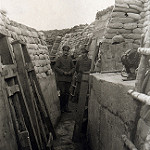
Leading the Troops

9362723445_85b224a5a0_q

Never has the role of a leader been more critical than when an organisation is undergoing a severe dislocation derived from a Change Management program.

The impact on the business could possibly be likened to how a soldier’s behaviour changed when faced with trench warfare in the First World War. In the trenches the soldiers lived in constant fear of having to go over the trench wall to face a highly risky and unknown future. To an employee, the analogy is unfortunately very similar! Consider the following:

1. Casualties
The soldier was continually seeing many casualties inflicted on their comrades by the enemy (the employee experiences many of their co-workers being made redundant and lives in fear that they too may also lose their job)

2. Lack of Information
Most soldiers were kept in the dark regarding the military mission and only saw short term actions which appeared to be rather foolhardy (employees do not fully understand the end goal of the Change Management, but rather judge the progress being made by how it is impacting themselves and their immediate coworkers)

3. Rumours
A lack of regular communication and dispatches from the military command resulted in many rumours spreading amongst the troops (if there is a lack of communication from management, rumours become rife and spread quickly throughout the organisation leading to poor morale)

4. Environment
The living conditions in the trenches became intolerable and basic hygiene quickly deteriorated resulting in discontentment and potential mutiny (employees will cope with poor work conditions and uncertainty for a limited period of time, however, should this continue many employees will seek employment elsewhere).

5. Recognition
Those soldiers who exhibited extreme courage were awarded decorations of valour, such as the Victoria Cross (employee contribution should be recognised and rewarded).

The military commander needed to have the ability to inspire and motivate the troops to have the mental and physical fortitude to leave the perceived safety of the trench and to risk their lives to fight the enemy to gain a forward position.

Here the manager must also lead their fellow employees along the Change Management journey to ensure the success of the business reorganisation, otherwise the structural change process will undoubtedly fail. Employees need to believe that their individual contribution is significant and will make a purposeful contribution to the long term survival of the business.

So before you raise your “manager’s sword” and utter that famous “charge” command, make sure you have considered all the aspects associated with the life of a soldier struggling in the trenches so you taste victory instead of defeat in your Change Management activity!