Cultural Transformation to a Tea!

Tea

I’m one of those tea drinkers that likes to have my tea in a long tall and transparent glass. There is something quite magical about observing the tealeaves gradually permeate their colour, taste and odour with the boiling clear water. With time, you will observe the tea colour swirling and leaving a distinctive trail in the water, with additional time, the tealeaves will transform the water into a uniform and translucent colour. The degree of tealeaf permeation, or transformation, can be controlled via the immersion duration time in the water.

Let’s take this analogy into the corporate office with respect to cultural transformation.

Many corporate cultures can be viewed like the glass of clear boiling water. To look externally at the glass, it is homogeneous, quite bland, and the only activity appears to be the vapour trail exuding from the top of the glass as a result of the high temperature (100C). However, unless something happens within the glass, the water will cool and the glass will reach a temperature that coincides with the surrounding room temperature. This is the boring corporate culture that is common in so many organizations today.

The key to cultural transformation is the introduction of a catalyst to initiate and drive change. However, prior to its introduction, the business management team need to identify and agree on what their unique and distinctive organizational culture needs to be? Let’s go back to the tea analogy. How will the business culture be defined? What will be its colour, taste, smell and intensity? How long will the process take to be achieved? What catalyst will be used to initiate and drive the cultural transformation? Will the employees, customers and the market like the final taste?

When tealeaves are added to the boiling water, the permeation can be accelerated via movement of the leaves, or the water itself via a stirring action. In other words, some action needs to occur to progress and maintain the transformation.

So when next you are considering the implementation of your next cultural transformation in your office, or if you are currently in the midst of one right now, may I suggest that you consider the following key elements:

1.A transparent glass enables your employees to see the degree of transformation permeation. Don’t hide the process, make it very visible.
2.Is the water hot? Is the corporate environment at the right temperature for the required cultural transformation?
3.What tea will be introduced into the water? What will be the catalyst that you will use to drive the change? What colour, taste, smell do you want to achieve that defines your corporate culture?
4.When should you introduce a spoon into the glass to stir things up a little? What stirring speed is optimum to achieve the desired effect?

Once the desired tea has been achieved, there is no point everyone just looking at it with admiration, make sure that all those involved in the transformation process drink the tea and provide management with feedback so the tea can be tweaked accordingly to maintain the optimum taste and enjoyment!

Don’t relax once you have obtained the targeted cultural transformation, as just like with tea, the organization’s tastes will change over time. Be prepared to continually experiment; maybe add some lemon, some honey, or another tea flavour to add that additional zest!

The Flamboyee

Mondrian dress

If you have ever watched a speedboat cutting through the still water in a large lake, it is a most impressive sight. Besides the monstrous noise catapulting flamboyantly into the surrounding air, in its trail there is a sharp and distinctive series of oscillating waves that permeate from the back of the boat and eventually make their way to the shore. As an observer, you have no option but to take notice and to acknowledge the visual spectacle that is quickly unfolding before your physical senses.

This occurrence got me thinking…..

Corporate innovation needs “The Flamboyant Employee” to act as a catalyst to inspire and to make others in the office think that little bit differently. As a suggestion, let’s call these people the “Flamboyee”.

As the “Flamboyee” wanders through the office, their profile captures the attention of their fellow workers. They may have a flirtatious smile, a wicked glint in their eye, wear a range of unique clothes, or possess some other individual and distinctive mannerisms and attributes. The key requirement is that people take notice of the “Flamboyee”, break their concentration and initiate a spark of innovation in their thinking, or in their subconscious. This “Flamboyee Effect” rippling throughout the office environment can be likened to the waves in the lake generated by the speedboat. Those employees in direct contact with the “Flamboyee” will tend to obtain the greatest innovation benefit.

It is important not to have too many “Flamboyees” meandering the corporate passageways; otherwise there could be a clashing of the innovation waves that may lead to a negative impact and eventual capsizing in creativity. However, a well-planned timetable of “Flamboyee” activity is essential to ensure that a sustained level of innovation buoyancy is maintained throughout the working day, particularly near 5 PM when many a worker’s motivation starts to quickly subside.

The role of the “Flamboyee” should be prized by management, and HR should have a specific position description prescribed with key performance innovation indicators to make sure that the “Flamboyee” is operating effectively and achieving their maximum creative potential.

Just a thought, but one definitely worthwhile exploring further!

The Script of Change

Theatre..

The life of an Actor is one of continual change. When the Actor is handed the script that defines their character in a theatrical play, they immediately immerse themselves into exploring their new role in a professional manner, as does all the acting cast. Initially, they may have some reservations or hesitancy on their newly assigned task, but they accept the challenge knowing that with time and practice they will eventually master what is required from them.

The Actor will also typically make extensive research into the profile of their designated role to ensure their performance in credible and consistent with the other performers in the play.

With time, the actors start to discard their own individual personality and begin to morph into the required behaviour that is required in order to ensure the required artistic success.

The parallels with that of an actor and an employee experiencing a corporate change management program are quite similar and many a business organization can learn a lot from the process.

The Script – In a corporate change management program the employees are typically provided with high-level objectives that they are then expected to deliver with a sense of urgency. (This is like handing the actor the script and then asking them to make a public performance with minimal time to prepare for their role. The result will undoubtedly not be optimum).

Role Practice – Employees are asked to modify their behaviour to be consistent with the required change management program. To many employees, this new behaviour may be quite challenging and inconsistent with their experience and skill set. (The actor needs time to practice and research their new role to make sure they get it right. They will make many mistakes prior to the actual performance, but these mistakes are opportunities to learn, modify and master their new role). Business management needs to provide employees with the skills required to deliver the change management program and to tolerate any learning mistakes made along the way.

The Props – Most corporate organizations use posters, videoconferences and other e-messaging techniques to try and support the change program. However, most are deemed to be superficial by employees and do not achieve the targeted result (In a theatrical play the stage is continually changed to support the actors and to create an atmosphere that embellishes the actors on the stage, and those observing off-stage in the audience). The corporate office provides a vast array of potential prop opportunities, some examples: why not move the CEO from their office to a desk out with the employees (a bit like having a military General out in the battlefield with their troops, rather than sending commands from the isolated HQ), move the employees to another external office which may have less of the corporate trimmings to signal the change in work environment and thought, or reposition work teams from their well established office position to other parts of the building (or into fragmented teams), etc, etc.

Have Auditions – many employees have been type cast into their existing roles based on their previous experience in those roles (An Actor auditions for a variety of different roles and is willing to explore new opportunities and characters). In a corporate change management program, employees need to be given a script that allows then to think differently and to utilise many of the skills that may have been hidden as they were only allowed to use some of their personality attributes that were consistent with their current role and job appraisal criteria. For a change management program to be successful, HR needs to allow employees to exhibit other creative and innovative flairs of skill that the organization may have actively suppressed (which may be one of the reasons why the business needs to now change!)

The theatrical play, together with the corporate change management program, will enjoy raptured applause and success when all the participants have been provided with the required time to practice, perfect their script, and have the appropriate props. The outcome will be a shout of “BRAVO” from the audience (and the business community)!

Serving up the Corporate Communication

dinner


Have you ever considered the humble beef steak and the many variations in which it can be prepared and served to meet the varying eating requirements of diners?

Some people like their steak raw, others partially cooked, others with a more highly tuned animalistic appreciation, savor it burnt with a delicate charcoal after taste that lingers just that little longer on the palate.

Others like their steak transformed into another eating format such as mince, a sausage, hamburger or even placed on a metal skewer garnished with an array of coloured complimentary ornamental vegetables to add that certain nutritional balance to the eating diet.

The overall result is that many people will happily eat steak owing to the customized presentation and delivery format that meets the endless variety of fickle needs of the consumer.

Let’s explore this thought with respect to corporate communications. Rather than having one single communiqué to the broader organization, a tailored message for each user group is required (you just can’t serve raw steak to everyone!). The message needs to be crafted to meet the consuming needs of each work group. Some groups will like to hear the message straight (don’t cut the fat off their meat), others will need it to be refined (cut into smaller more palatable pieces), some will need it simplified and reduced (via the use of a food processor), others may want some condiments to compliment the taste of the message.

In all the above message scenarios the origin of the communication is the same (just like the original cut of the steak) the skill is in how the Corporate Communication Director (or should I say chef) dishes up the “meat” to ensure that each employee (diner) eagerly greets the communication and is ready to eat it all up and is fully satisfied without the need for seconds, or a dessert!

So in summary, corporate communication is really just food for thought…..isn’t it?


The Gravity of Change

Apple on the ground

Gravity is one of those laws of physics that you know will work in all circumstances, what goes up, must eventually come down. The only variable is the rate of descent.

This creates an interesting opportunity in the establishment of a culture of “change” in the corporate environment. If the change is to work effectively, it must start at the top of the organization. Once in motion, the law of gravity comes into play and the change gradually permeates down through the whole organizational structure. The higher the starting point of the change, the greater the momentum and the better the chance of success in the change reaching the lower levels.

However, if there are any resistors to the downward movement, these blockers should be quickly identified and removed to allow the continued progression of change.

Gravity also ensures that change proceeds only in the required direction. Should a change start progressing in an undesired path, gravity will naturally implement the appropriate course correction.

One problem with gravity is that change has minimal impact on the corporate organization if it starts at the bottom. Here the change will have a limited life and will quickly run out influence and will eventually stop.

So next time you observe the influence of gravity in your surrounding environment consider how it can be used to implement an effective program of change in your corporate organization. Don’t fight the laws of physics, but rather, use this proven law to your advantage and let gravity do the work. But make sure you start the change at a high level to achieve the maximum impact.


Eyes Down with a Positive Perspective

cemstride

When sojourning around the corporate office you will encounter a variety of co-workers with differing walking styles. Those people who are confident will typically walk with a sense of purpose and will greet you with a determined look that locks their eyeball with yours. Others who are less positive by nature will tend to waddle around the building with their eyes well entrenched with a downward stare and minimal opportunity for communication.

Many an office will parade an endless array of motivational signage on the office walls to encourage people to change their perspective and to react in a more optimistic manner. However, there is an untapped opportunity for inspiring those with a downward glance whilst walking throughout the building that utilises an office environment that is frequently under utilised and ignored from a marketing and change management directive, that being the floor!

The floor provides an intertwining matrix of messaging possibilities:

Different Carpet Colours
Why do all carpet colours need to be consistent throughout the building? Why not create a pictorial affect to inspire people who work within various departments? For instance, those in marketing could have an outer space carpet with an endless array of stars and galaxies to help inspire a creative thought? Those working in finance could have a carpet with many numbers, $ signs and mathematical formula permutations? Those in HR, could have a multitude of employee faces beaming up at them to reinforce the diversity of culture within the business?

Safety Messages
For those danger areas where people collisions may eventuate, why not have some floor signs saying “Beware, slow down and exercise caution otherwise there may be unwanted facial contact”?  Or, in the canteen, “Look out for slurping coffee carrying colleagues!”

Management Notifications
When a senior manager is approaching, a floor notification could be transmitted to approaching co-workers stating “Be happy, smile, look like you are busy!”

Personalised Walking Tones
For some co-workers that need that extra form of encouragement, the floor would have the ability to read certain employee feet and walking styles.  For those individuals identified, an appropriate piece of “power music” would blast out from the floor to give them that psychological lift whilst moving throughout the building!

There is an endless array of floor possibilities in the corporate office. The key is to start viewing all aspects throughout the building that “little bit differently”! May these innovative and creative ideas lead to hours of happy and positive walking in your place of work!


Leading the Troops

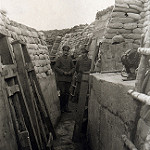
9362723445_85b224a5a0_q

Never has the role of a leader been more critical than when an organisation is undergoing a severe dislocation derived from a Change Management program.

The impact on the business could possibly be likened to how a soldier’s behaviour changed when faced with trench warfare in the First World War. In the trenches the soldiers lived in constant fear of having to go over the trench wall to face a highly risky and unknown future. To an employee, the analogy is unfortunately very similar! Consider the following:

1. Casualties
The soldier was continually seeing many casualties inflicted on their comrades by the enemy (the employee experiences many of their co-workers being made redundant and lives in fear that they too may also lose their job)

2. Lack of Information
Most soldiers were kept in the dark regarding the military mission and only saw short term actions which appeared to be rather foolhardy (employees do not fully understand the end goal of the Change Management, but rather judge the progress being made by how it is impacting themselves and their immediate coworkers)

3. Rumours
A lack of regular communication and dispatches from the military command resulted in many rumours spreading amongst the troops (if there is a lack of communication from management, rumours become rife and spread quickly throughout the organisation leading to poor morale)

4. Environment
The living conditions in the trenches became intolerable and basic hygiene quickly deteriorated resulting in discontentment and potential mutiny (employees will cope with poor work conditions and uncertainty for a limited period of time, however, should this continue many employees will seek employment elsewhere).

5. Recognition
Those soldiers who exhibited extreme courage were awarded decorations of valour, such as the Victoria Cross (employee contribution should be recognised and rewarded).

The military commander needed to have the ability to inspire and motivate the troops to have the mental and physical fortitude to leave the perceived safety of the trench and to risk their lives to fight the enemy to gain a forward position.

Here the manager must also lead their fellow employees along the Change Management journey to ensure the success of the business reorganisation, otherwise the structural change process will undoubtedly fail. Employees need to believe that their individual contribution is significant and will make a purposeful contribution to the long term survival of the business.

So before you raise your “manager’s sword” and utter that famous “charge” command, make sure you have considered all the aspects associated with the life of a soldier struggling in the trenches so you taste victory instead of defeat in your Change Management activity!

Are You on the Bus?

Double decker bus - London

In many change management programs within business you would have heard the phrase…”Are You on the Bus”?

Let us explore this analogy a little further. Many of us when at school have experienced those bus excursions which were brilliant, and others that were a complete disaster. So what are some of the key elements that differentiated the two experiences?

The Good:
The Bus Driver was a great storyteller that engaged the passengers throughout the journey.
Your fellow passengers created their own excitement and fun.
The scenery from the bus windows were continually varied and made the view a delight to behold and appreciate.
Passengers moved around the bus to experience different perspectives on the journey.

The Bad:
The driver was an utter bore and provided zero inspiration.
The passengers did not interact, were silent and uninterested.
The view outside the bus was monotonous and made the passengers switch off because they were not engaged by the scenery.

So what are the learnings with the bus analogy for management?

The driver is critical! Managers need to have the ability to inspire and lead their employees along the change management journey so they are eager to participate in the activity.

It is important to motivate the co-workers who are already on the bus so they inspire their fellow passengers so nobody wants to get off.

Passenger comfort along the journey needs to be maintained. Here the manager needs to understand and appreciate how their employees are feeling emotionally and physically. If the temperature or mood is too hot or cold, it is the driver who is on control of the air conditioner and needs to make the required organizational climatic change.

However, there might be some passengers who really don’t like the journey. If so, just let them off at the appropriate bus stop otherwise they may become a negative influence on the other passengers.

The bus may hit a large pothole in the road and get a wheel puncture? If so, the bus should quickly stop and address the problem and take the required corrective action to ensure that a smooth ride continues along the route to the intended destination. There is no point limping along with a damaged bus as it will negatively affect the experience of all the passengers.

So when next you as the driver (and manager) are about to start your next bus journey of change management, make sure you consider the above and then jump into the driver’s seat, start the engine and put your foot down on the accelerator and go!


Timing your “pop” just right!

281/365 - pop the bubbly.

Consider the champagne bottle from an anticipation perspective and I think you will agree that it is a world recognised winner on all fronts! So what is the key to its success?

The Shape
It is an impressive design that is bold at the base and sleek at the top that commands a prestigious occupation position when situated on the shelf with less humble bottles.

The Wrapping
The combination of a sophisticated bottle label with a wired opening mechanism is an engineering masterpiece.

The Cork
The unleashing of this pressurised stopper announces the progression of a carbonised fluid stream of enticing drinking refreshment culminating in a distinctive and highly audible popping sound!

So, when the champagne bottle that is characterised by its shape, wrapping and cork, is introduced into any party or special occasion, it is always greeted with an air of rapture and excitement!

But once it is opened and all the contents have been consumed, the bottle is now viewed with a past sense of occasion and one now spent. It can only be popped once, so the moment is eagerly cherished by all beholders.

In the corporate environment we can learn a lot from the champagne bottle when making any strategic announcements as you only get one chance to get the impact of the “pop” just right! Get it wrong and your important message becomes a fizzle.

The key is to gradually build and promote the anticipation via a combination of carefully scheduled pre-positioning communication snippets so when the time is optimum, your message goes off with an impressive “pop” and is immediately appreciated by all employees.

So focus on the timing and make sure that you get that “pop”……just right!

Cheers!


The need for more noisy hot air!

Hot air Balloons

Yesterday, my early morning predawn walk of individual thought solitude was rudely interrupted by the sound of a large whooshing sound overhead!

On looking upwards, I sighted an impressive and colourful hot air balloon meandering through the clouds with a crew of delighted occupants peering over the edge of the basket gleefully looking down at me.

I became enthralled with the upward view as I listened to the random bursts of hot air blasts that the pilot used to reposition the balloon strategically in the sky. As the hot air balloon climbed to greater heights, I lost sight of it momentarily in between visual and audible “trackers” associated with the gas burner used to replenish the heated air.

The thought of these “trackers” I found interesting from a business perspective, particularly for those companies involved in the implementation of Change Management. During a time of structural change, employees need to have a reference point which reconfirms that progress is being made within the organization. In the case of the hot air balloon that was camouflaged within the clouds, these were the sounds and sights of the gas burner that punctuated its progress. In the business world, these “sight and sound trackers” could come in a variety of forms such as; financial targets, management forums, employee surveys, morale or via other external measures. The key is to have these “trackers”, and to promote them regularly as the Change Management “hot air balloon” travels towards the desired end goal (or “landing position”).

So for all you who are involved in piloting your Change Management process……make sure you make lots of noisy hot air!