
Why not “Think Inside the Time Box”?

Time Jumper

This morning ritual of having breakfast in the Virgin Lounge at Melbourne airport was becoming an all too familiar experience. [1]

After satisfying my early morning Maslow’s basic survival needs with a long black coffee, wholemeal toast with lashings of vegemite, a petite bowl of muesli, I then mentally consumed the words in my newspaper looking for that insightful and learned spark of wisdom. Five minutes later, possibly six at a stretch, I had quickly come to the conclusion that I was bored. There was now only one thing for me to do in order to fill-in the time before I boarded my flight to Sydney, and that was to observe my fellow business travelers.

After a few minutes of visual critique, it became very apparent that the long sought personal goal of individual creativity which defined everyone as a unique individual, had somehow slipped between the cracks that morning. The more I looked, the more I could see many of my yet unknown business acquaintances partaking of coffee, cereal, toast with the occasional variant of a random accompaniment of difference (eg marmalade or honey), but in essence the selected diet was remarkably the same.

We wore similar suits, ties, cuff-links, shirts with that all too familiar checked pattern and colour, read the same newspapers, and even looked at each other with that same inquisitive look when a wild animal is startled from its habitual and comfortable lifestyle by an oncoming car headlight.

This got me thinking. How can we be creative if we are all seeking business innovation and inspiration via the same sources of knowledge and thought? The well-known term “thinking outside the box” came to mind, but is this the right way to discover new ideas? If we are all following the same methodology, all reading the same editions of the Harvard Business Review, the same business books, following the same sports, eating the same food, well, our sight outside the box is rather flawed and certainly lacks that required long distance vision, it will also be the same view as everyone else!

Why not try something a little bit different? Why not “think inside the box”, but with a major difference, that being time as a variant? There is a lot of untapped idea history “inside the time box”, the key is to open it up and use it. Many potentially brilliant ideas have literally died with creative thinkers of past generations. If their ideas had been passed down between the ages, their insights may have formed the basis of many unusual and different innovations that could only be fulfilled with the progression of time and today’s technology.

Alas, time travel is not possible, but what about actualising the environment and thought stimuli of past creative thinkers to excite and enlighten you and I today? The method is quite simple. Why not consider the following past time ideation starters:

  • Dress up in period costume and wear those antiquated spiffy clothes in the corporate office?
  • Don’t read today’s newspaper, read some old papers and get an appreciation of the business and life customs of the past?
  • Forget the long black coffee in the morning, have an old English ale instead? (assuming your HR Manager is OK with the concept)
  • Don’t drive to work, walk or take your personal horse and buggy?

I’m sure the experience would lead to some different and creative thoughts being established as you think” inside the time box”. Your business colleagues will also have the benefit of thinking differently as they observe you in the process of historical thought change and will marvel at your self-confidence and creative fortitude.

So next time you are sitting in the Virgin Lounge at Melbourne airport awaiting your flight, try and consider what you can do to implement some small amount of thinking “inside the time box”, I’m sure it will lead to a noticeable creative point of difference in your life. If the concept is too great to publicly display, then why not start off with a lesser innovative step, don’t have a long black coffee, have a soy milk chai latte with honey instead!

—————-

[1] The Suit Trouser Length Creativity Index
https://thinkingfuturethoughts.wordpress.com/2014/09/01/the-suit-trouser-length-creativity-index/
Don’t Hit The Delete Button

wileecyote

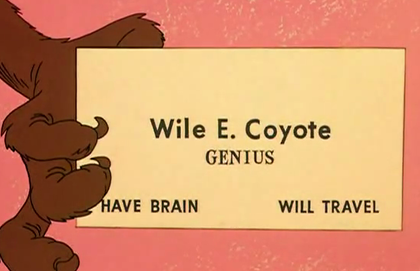
The name on his business card said; “Wile E. Coyote”. The job title said “Genius”.

I pressed the record button on my video recorder that signalled the start of my long awaited interview with Mr Coyote.

Me: “Mr Coyote, or would you prefer that I call you Genius?

Mr Coyote: “No, please call me Wile, although some people do call me “Super Genius”, Wile is just fine.”

Me: “OK, Wile, let’s jump to the reason why I’m here. As a “fictitious writer” with the Harvard Business Review, my readers want to know what you have learnt after all those years of unsuccessfully chasing the Road Runner. Your planning skills were impeccable, your implementation was run with the punctuality of a military operation, yet you never managed to attain the prize you sought.

Mr Coyote: (sigh)

Mr Coyote: (second sigh)

Mr Coyote: “If I only knew then what I know now, but experience is indeed a most valuable resource that can’t be bought, or rushed. I will try and summarise my learnings into two key points so as to make it easier for your readers to understand.

Point 1: I’m actually a vegetarian, but didn’t know this at the time of my Road Runner chases. Apparently my metabolism can’t cope with meat. I wasted years of my life, thousands of dollars on birdseed, explosives and online purchases from the ACME Company for products that served no benefit to my ultimate nutritional well being!

Point 2: Sit back and take the time to learn from your mistakes. If I had only sat quietly in the cinema and observed all my cartoons, I would have seen an accumulation of consistent errors. Unfortunately, it was like someone had pressed the delete button on my memory as I’d always forgotten what I had learnt from each Road Runner pursuit. I could blame the brothers Warner for this, but I only have myself to blame as I was more focused on my “Super Genius” status as was quite prevalent with most Hollywood movie stars of that era”.

We talked for another couple of hours about his life, his romances, and his colourful and very animated life and then departed as good friends. It was a most enjoyable interview.

As I was writing up my notes for my editorial, I recalled his words about the “delete” button. How many of us quickly delete failed life experiences, phone conversations, writings, presentations, memories and other forms of people interaction? Why do we not welcome the opportunity with a positive mindset to move forward and to ensure our steady progress?

Yes, Mr Wile E. Coyote was indeed a real Super Genius…..

Taking Your Brand to New Promotional Heights

Searchlight

According to my trusted meteorological iPhone app, the timing looked just right. It was 2:04 PM and by my reckoning, the clouds were at the optimum “Genus Cumulus” appearance so I should achieve the desired picture “hang time distribution” before the visual sight was dispersed by the wind. My calculations indicated that I should have about 10 minutes to brand my customised CV message to the population of New York.

I quickly glanced once again on how my image and brief professional experience synopsis looked on the “LinkedIn Cloud Projector” in preview mode, yes it all looked good. I was hoping that the QR code would come through with the right definitional clarity so potential business prospects could scan my profile details with ease. My only concern was the timing of the 2:05 PM supersonic Virgin Atlantic flight from London to New York as it could cause some cloud turbulence when it commences its gradual decent into JFK airport, but that’s one of the risks associated with personal cloud advertising these days.

OK, it was now time to press the Cloud Projector button and start the process. Immediately a thirty square kilometre coloured, and rather snazzy image of myself was beamed skywards with vibrant intensity. I was also pleased that I had spent the extra dollars on the additional promotional advertising, as suggested by the LinkedIn sales agent, as the large sonic boom with the accompanying missile explosion at 2000 feet above the New York skyline appeared to have caught the upwards attention of the New York crowds particularly nicely.

I smirked with some personal pride as my large handsome face (well, I thought so anyway) beamed across from above, that was, until that pesky Virgin Atlantic flight descended through my left nostril. However, I was relieved, as the QR code seemed to remain intact. For the next few minutes I watched as my portrait hovered quietly above New York until some high level winds decided to take one ear in the direction of Newark, the other towards Brooklyn. A few minutes later I had vanished into the upper atmosphere, except for my left eye, which remained with a look of naughtiness down on the city, then, with a final momentary wink, that also eventually disappeared.

Suddenly, I was awakened from my feeling of self-righteousness by the continual interruption of text messages on my phone. Yep, it appears that the “LinkedIn Cloud Projector” advertisement had worked! However, when the forty-first text message arrived, I was immediately brought back to reality, it was the LinkedIn invoice. Oh well, I suppose that’s the price of corporate fame!

It’s That Fabric

Tartan Dress

The year is 649 BC. Snuggled in front of the large open fire sits a cross-legged, middle-aged Celtic man with a scruffy reddish beard. He has just received his invitation to the official lamb annual sacrifice and he is all in a quandary as to what to wear for such a significant occasion. He looks rather forlornly at his tatty worn breaches and looks deep into the glowing wood embers for some fashion inspiration whilst quietly sipping on a wee dram of a noxious fermented barley brew. After a few hours, his throat is scourged of all feeling, his beard is nearing the stage of spontaneous combustion and his eyes are wishing they were positioned in the back of his head so as to avoid the fierce radiant heat. But with a surprising, and somewhat unexpected experience, a creative and unplanned thought begins to permeate and develop.

The year is 689 AD. A fierce battle is being fought in the land of Killiecrankie. Leading the charge is a gallant man called McDonnell. He, and his band of impressive warriors, are bamboozling the enemy with a distinctive coloured uniform that flaps loudly with repetition in the cold Scottish highland wind against their large hairy thighs as they confront their foes with swords extended.

The year is 2015 AD. A young woman walks along the platform of a London underground tube station wearing a patterned red dress that turns many a head yielding a look of awe and bashful uncertainty. The pattern is traditional, complements her lipstick, and is minimal in fabric volume and body coverage. However, the wearer is not perturbed, as it has achieved the required visual objective of individual differentiation.

Yes, there is only one fabric that can achieve all of the above unique personal requirements, and more! This fabric is a creative combination of different colours, lines and squares that the observer could only assume was initially a creative mistake. Yet, it was not made in error. No, it is a handiwork of true fashion innovation and one that has travelled successfully throughout the ages and will continue well into the future.

It is known by the name of “tartan” and it is immediately recognisable by populations and cultures across the globe. It identifies the wearer with a persona of difference, and one that is prepared to cross the boundaries of tradition, particularly in this day of corporate fashion conservatism.

So, next time you are trying to instil and propagate a culture of innovation in your corporate organization, the choice is simple. Wear a tartan item of clothing, and you will be noticed and definitely not forgotten!

Dress for Success

Untitled

Perched with a seal like physique, and with toes just residing on the edge of the starting blocks, the swimmer’s ears desperately listens for the starters gun to allow their body to be catapulted into the pool.

Comment: Now this is probably the “verbage” one would expect to read when describing such an activity, but no, I will be observing the swimming race from an entirely different perspective.

If you were to study the appearance of the swimmers, you would witness them all to be wearing sleek, body hugging bathers, or they would be similarly equipped with a freshly shaven and ultra-smooth body brandishing the most microscopic swimming costume that just avoids an exhibitional “R-Rating” classification. Gone are the days of seeing a daggy, loose fitting, hairy chested (yes, I am talking about men), bawdy, bather clad swimmer who looked like they were preparing their large belly for the high gravitational impact of a maximised “bomb” splash. Yes, these people do still exist, but only in certain residential suburbs that you and I tend not to frequent (well, maybe not state publicly anyway?).

Those swimmers that have the objective of wanting to win, tend to “Dress For Success”.

The key word here is not “success”, but actually “dress” and no, I’m not saying that everyone needs to actually wear a dress to be successful. Rather, successful people have an individual fashion statement that captures the true essence of their personality and which defines their own distinctive uniqueness. In a similar way to the “Impressionist Master Painters”, their brush strokes and use of colour, created works of art that truly defined their signature, even if they didn’t actually sign the painting. People just needed to view the painting, upon which the artistic origin was immediately recognised.

The successful swimmer combines the requisite sports swimming costume with their own brand of style and technique when in the water. Similarly, powerful and influential people have their own fashion persona that identifies them with a tailored clothing statement via the selection of a range of accessories such as ties, shirts, suits, shoes, socks, cuff-links, aftershave, perfumes (I was thinking woman, but each to their own), hairstyles and suchlike, that when combined by them supports and reinforces their personal and publicly branded message.

So as that old phrase goes, “Clothes do indeed maketh the woman and the man”. If you want to look like a bogan, well, dress like one and you will be treated as per the appearance you portray. But if you want to look like a winner, then dress accordingly.

Now for those of you that wear a kilt, the verdict is indeed still out on this one! However, if you wear a bow-tie, no more needs to be said!

Corporate Office Time (COT) – Redefined

blond girl

Her name I believe was Susan, but that is somewhat irrelevant as she should have been any one of us.

Susan meandered in through the main office reception area and immediately everyone’s eyes were fixated upon her. All business activities ceased, it was like “Corporate Office Time” (COT) had stopped with her physical presence. Once the Susan persona had moved past, the only evidence that remained were the quiet rumblings of gossip and consternation.

No, it wasn’t just Susan’s long blond free flowing wavy hair, nor her brightly coloured jeans, her loose fitting and fully button collared casual silk shirt, the coloured toenails, or that distinctive walking style, it was the combination of all these attributes that when combined together created a unique and quite distinctive point of difference. Susan certainly did not portray that traditional and well-entrenched corporate look of conservatism, her appearance just didn’t “fit in” with the “corporate standards” of this office!

If we were able to take a snapshot of COT in the past, and in the future, to observe and compare the changes in “corporate standards”, the viewing I’m sure would be rather interesting and revealing.

In that 1960 classic film called “The Time Machine” (H.G. Wells), the character portrayed by the actor Rod Taylor, observes a female clothing mannequin in a shop window where he sees women’s fashion literally changing before his eyes.
(Ref: https://www.youtube.com/watch?v=BVlr24zD_KQ)

What is classified as acceptable business attire in one period of COT may be completely inappropriate in another point in time.

This then begs the question, what initiates the change and who deems it acceptable? Should this change in corporate standards be subtle, or one that causes a major dislocation in the office cultural environment? My preference is the latter, one that forces a change in the innovation mindset of employees and makes everyone think that little bit differently. After all, we are not all privy to having access to a “Corporate Office Time Machine” (COTM) where we can test the impact of future ideas before we implement them, so let’s just get on with it and enjoy the uncertainty!

The corporate office needs more people like Susan as these employees have the courage to introduce new and innovative ideas that continually test the boundaries of COT. These people force others in the office to review current “corporate standards” as the window of what is termed “acceptance” needs to be regularly expanded, just like the shop store fashions in “The Time Machine” film.

So, let’s stop focussing on the past and start excitedly introducing the future into the present!

Note: The image is of Weena (http://en.wikipedia.org/wiki/Eloi)

Claim your own Aphrodite Charm!

photo (1)

“How many times do I need to tell you Aphrodite? Could you please take off those unsightly mortal business clothes of yours and put on your official white deity long gown! You need to remember that you are a Greek goddess, so please dress like one! Apollo, Poseidon, Athena and I, are all sick and tired of seeing you in those brightly coloured short skirts, shirts, patterned stockings and high-heeled shoes! That look might be just fine for those “creative types” that you mingle with surreptitiously in the corporate office below on earth, but up here above the clouds some professional god-like decorum is required! One day, those pesky and inquisitive passenger airlines might actually see you in that coloured attire and our nice quiet world of the perceived theoretical mythology with vanish immediately and we will be inundated with human sightseers!”

“I hear you Zeus, don’t get your toga all crumpled and frazzled! You might start looking as old as you actually are if you don’t settle down and relax! It’s all right for you lot all pontificating about life, the universe and everything Greek up here in your godly world, but without me taking the initiative and dropping down to the world inhabited by mortals now and then, no new ideas or thoughts would ever make it up here into this sterile life of perpetual bliss!”

“Thankfully my “Aphrodite charm” and sophistication makes it quite easy for me to morph into the business organizations I choose to infiltrate where I can quickly manipulate the desires and intentions of their CEO. If you lot followed a similar strategy and moved outside your comfort zone, you might discover there is a vast array of knowledge to be learnt and absorbed down there!”

Let’s park this Greek godly dialogue for a moment and consider the work environment of those fellow mortals (just like me) who may be reading this blog post.

Yes, the key is to make the time and effort to step outside your known networks of understanding. To do this successfully, you may need to encounter some personal discomfort and to accept that your traditional business methods and work practices may not be the best, nor the only way to do things. It is also so important for us all to courageously branch out from our normal and stayed circle of friends and business acquaintances, and to have a willingness to genuinely learn from others. From these new experiences, new and exciting ideas will potentially merge and propagate.

So next time you are travelling on business and are happily looking down on the clouds from your snug and comfortable aircraft window seat, remember that you too are capable of exhibiting that “Aphrodite charm” of creativity and innovation by thinking just that little bit differently!

Seeking that Optimal Balance

10863647583_75b3c791a5_q

The rather assertive, and I thought rather scary young woman, dressed impeccably in the bland and very dark company coloured uniform, beckoned me forward as I was next in the line and requested my name. Without any hesitation so as to not potentially upset her, I quickly replied, “CRAMER, Steven”. My name was immediately crossed off the list.

She, although her name badge said ‘Mandy’ (I wouldn’t dare call her this for fear of appearing too friendly) then asked me and my luggage to stand on the scales to which the total weight was duly recorded with minimal facial expression nor interest.

I was then given my helicopter boarding pass which specified my seating position for the short flight out to the off shore oil platform in Bass Strait some distance off the Southern Australian coastline.

All this procedural rigmarole was apparently required to ensure the helicopter weight was balanced from a safety perspective as we traversed the fierce, and somewhat unpredictable, cyclonic wind gusts to our offshore destination.

Now this got me thinking about the corporate office and how the business tries to “balance” their people skill sets to achieve the best chance of success. Well, I say this comment a little bit tongue in cheek as most organisations unfortunately don’t actually do this aviation procedure of ‘skill balancing’ particularly well. If they were indeed a helicopter, I suspect many of them would be flying along lopsided with a predominance of accountants, HR, engineers, extroverts or introverts! No wonder many companies tend to plummet to their financial doom and fail to obtain their targeted business objectives!

As each business objective may be different, management (just like ‘Mandy’) need to plan accordingly to ensure the right ‘weight’ mix of skills are on board. This skill set will often change based on the task and velocity of the objective required.

Now when potential danger looms, a pilot may reluctantly jettison a selected item from the aircraft to avoid jeopardizing the entire mission. Should a business encounter unexpected climatic economic turbulence, it may necessitate the ejection of some awkward and oversized individuals who are exacerbating the effect. If this needs to be done, the kind and humane approach is to provide these people with a personalized parachute before pushing them out the door, but there are some mean spirited and callous managers who like the free-fall spectacle. For those who choose the latter, may I remind them that what goes up does eventually come down, and lands with a massive hard thump!

Yes, it’s all in planning which bottoms you want in which seats in your next business mission. Without the right “bottom balance” it could be a rather uncomfortable and long flight.

One final comment and it relates to the scenery the business will observe as you travel to your intended destination and this relates to your choice of navigator. For the optimum journey of learning and excitement, may I suggest placing a creative individual in this role and your flight will never be boring!

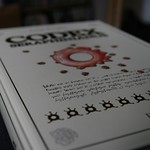
Codex Seraphinianus

The Codex Seraphinianus

Today I was reading a Twitter post by Maria Popova (http://t.co/RdK5JUZsOI) about Luigi Serafini and his encyclopaedia called “Codex Seraphinianus”. The following is the first paragraph from Maria’s post;

In 1976, Italian artist, architect, and designer Luigi Serafini, only 27 at the time, set out to create an elaborate encyclopedia of imaginary objects and creatures that fell somewhere between Edward Gorey’s cryptic alphabets, Albertus Seba’s cabinet of curiosities, the book of surrealist games, and Alice in Wonderland. What’s more, it wasn’t written in any ordinary language but in an unintelligible alphabet that appeared to be a conlang — an undertaking so complex it constitutes one of the highest feats of cryptography. It took him nearly three years to complete the project, and three more to publish it, but when it was finally released, the book — a weird and wonderful masterpiece of art and philosophical provocation on the precipice of the information age — attracted a growing following that continued to gather momentum even as the original edition went out of print.”

My first reaction on reading this was, “What a brilliant concept!”.
My second reaction was, “Why do we never see such creativity in the corporate office?”
The third reaction was, a repeat of my second reaction, “Why not?”

For a corporate organization to be innovative, it needs to be allowed to think. It’s employees need to be provided with the opportunity to have random, creative thoughts that are not inhibited in any way, but are allowed to run free.

In my blog (https://thinkingfuturethoughts.wordpress.com/) I have written many posts trying to inspire those in the corporate office to think that little bit differently. Yes, some of these posts are a little bit way out, but that’s very much the intention. A previous blog post called “The Room of Thought” typifies some of this thinking; (https://thinkingfuturethoughts.wordpress.com/2013/08/29/the-room-of-thought/)

It’s gratifying to hear that many corporate organizations are now using my blog posts as “thought starters” for their employees, but companies need to do more and strategically embed creativity into their cultural DNA. Unfortunately, for some CEOs, innovation is merely just lip service.

The concept of “Codex Seraphinianus” is a fantastic example in “thinking that little bit differently” and inspires those reading it to open and expand their imagination. It breaks all the traditional rules, which I can only applaud.

Yes, this is my first book review and I give it 4.5 out of 5. Why not 5? Well, the score of 5 has been reserved for your own version of “Codex Seraphinianus” of which you will be the author. This version will I’m sure be a creative masterpiece!

The Vertical Room of Study

The Americans in Canada

It is 8:28 AM and there are a mass of people all waiting rather impatiently for the sky rise elevator doors to open. Finally, the elevator arrives at the Ground Floor Level and the doors slowly open. I quickly enter with purpose and strategically position myself in the back corner of the elevator after appearing to nonchalantly press the illuminated number 39 button. After disguising my external and gleeful anticipation, I then surreptitiously prepare myself mentally for the long ride to my lofty office floor destination.

Some people could be rather bored with the time taken for their vertical ride to tediously meander up to the 39th Floor after continually stopping at many interim floors along the way, but not me! This time is precious as it allows all elevator participants some brilliant people observation and study opportunities! If you haven’t seized the chance to really look at your fellow elevator incumbents, then you really haven’t lived as it contains a microcosm of creativity!

This creativity is quite personal and exhibits itself in many public and rather clandestine forms. The joy for the watcher is in the identification and discovery process which may be rather transparent to those who do not appreciate the visual and sensory clues that are being portrayed within this closed people transportation cubicle.

In case you don’t know what I’m talking about, let me provide some additional information so you too can ponder this creative and informative elevator experience.

Firstly, let’s talk woft. Yes, woft. First thing in the morning, your fellow workers will apply a variety of personal fragrances, with fluctuating levels of intensity, to all parts of their body. These fragrant wofts go under the common names of perfumes, aftershaves, moisturisers, hair gels, deodorants and other secret body embellishments. To add to the mix, there are also those people that don’t believe in fragrance enhancement in any form, shape or application. The result is a composite array of woft that frequently changes in line with the differing elevator assortment of occupants.

Then there are the clothes. There will be a jumble of suits, skirts, dresses, shorts, jeans, ties, scarves, socks, shoes and even the occasional sporty look. The colours embedded into these fabrics will generally cover the full spectrum range of the PMS colour palette (except for some strange reason in Melbourne where the colour dark grey or black seems to dominate). Once again, each elevator ride up and down the building will have its own unique colour and clothing dominance.

And yes, the elevator also provides a fool-proof tool for evaluating whether someone is an introvert or an extrovert. Your classic introvert will typically stand up against the elevator wall, look down at the floor and say absolutely nothing. Whereas, your flamboyant extrovert will tend to position themselves within the central people mix and their eyes will be continually darting around looking for a fellow extrovert to initiate a meaningful, typically loud and engaging conversation. Now should you encounter a whistler in the elevator, this usually signifies a frustrated extrovert who just can’t refrain from communication any longer and is about to socially and verbally explode!

I know what you are now about to ask! What about the mobile phone user? Well, there is no benefit achieved by studying these elevator travellers, yes, none at all. Why? Because these people are fundamentally rude and are therefore insignificant and irrelevant from a creative and academic perspective. However, there is a solution. One option is to construct an elevator that is impervious to mobile phone reception (which is quite a common occurrence with the mobile network my company uses). The other, and more economically acceptable option, is to have an inbuilt sensor within the elevator that initiates a torrent of polite verbal abuse telling the person to desist immediately. I was going to suggest some choice descriptive expletives, but as all elevators carry a “G Rating”, this idea just wouldn’t pass the globally accepted standards of elevator etiquette.

So, if you are in the business of corporate change management, HR or team building, an inexpensive and unique “room of study” awaits you, that being your elevator. Next time you take a vertical ride with your colleagues, may I suggest you ponder the woft, the clothes and observe any introvert or extrovert tendencies. I’m sure that many innovative learnings will be presented for your benefit!