The Experience of E-Class Flight

Annex - Grant, Cary (Only Angels Have Wings)_05

Once again, I had to go through the drudgery of booking my Qantas flight QF9 from Melbourne to London. It was a business flight that I reluctantly did every month, I loved it when I arrived at my London destination, but the long flight, well, I despised every torturous hour associated with it.

Owing to the frequency of my travel, the online booking process typically only took me a few minutes to complete. As usual, I entered my well-versed Qantas Frequent Flyer number, but once done, a new and rather unexpected screen mysteriously opened up in my booking. Initially I was a tad flabbergasted, as I was accustomed to seeing the usual cabin selection options of First, Business and the various Economy options. But this time, I was presented with some rather unusual seating option classifications; S, F or E to which I was quite intrigued. Apparently, owing to a combination of my lofty Frequent Flyer status, and my personal profile (possibly also due to my habitual bow-tie wearing fashion statements as professionally noted by the more discerning Qantas flight stewardesses), I had been offered the opportunity to participate in a rather unique test flight to London. I was then provided with an option to proceed, or to go back to the booking screen of normality. I had 30 seconds to make my choice. After a brief microsecond period of some limited superficial in depth thinking, I had quickly made my decision and without any hesitation selected the button marked “Go for it”.

Immediately, I entered a new and differently badged Qantas booking screen and discovered that S = Serious, F = Fun and E = Experience. Without going into all the aircraft cabin classification descriptive paraphernalia, and for the sake of verbal brevity, all you need to know is that I selected E-class (and checked the 12 page disclaimer box to confirm my booking).

A few days later, I arrived at Melbourne airport dressed in the minimalist clothing as prescribed by Qantas for the newly designated E-class traveller. Once checked in by the delightful and somewhat suspiciously and rather endlessly smirking Qantas staff, I was handed my E-class travel kit. In it were some face masked goggles, a tight fitting Qantas embroidered and personally monogrammed rubber suit that made me look like a spiffy surfer, some matching rubber boots, gloves and snug hat (we didn’t need to wear the latter until further advised). I was then ushered into an impressive private Qantas Club Lounge and saw a variety of other cautiously optimistic travellers.

There were those dressed like me, some looking slightly embarrassed as these suits were so body hugging that nothing was left to the imagination. There were others dressed in the traditional long haul international air travel casual attire; apparently these people had booked F-class. There was a small minority dressed in their stock-standard business suits, skirts, and other conservative items; they were obviously the S-class travellers.

A few minutes later we boarded the plane, but I was soon to discover that this was no ordinary Qantas plane, far from it. As I was in E-class, we boarded first as we had to make our way to the rear of the aircraft.

As we walked through the plane, the first thing that was immediately apparent was that the usual row of passenger seats had been removed. In the First/Business class seating location, there was a range of individually placed workstations, desks, sofas-chairs, computer screens, private sleeping booths, showers and a fine dining restaurant. This was S-class and it was designed for the serious business worker!

In the middle section of the plane, F-class resided. Here a vast array of computer games, cinemas, snooker tables, dartboards, massage rooms, spas, saunas and a healthy organic restaurant was located. This was an area that encouraged fun, frivolity and definitely no work. For those passengers that were a little bit overcome with too much excitement, there were large brightly coloured beanbags, lounge chairs and some private sleep booths.

After a few minutes I finally arrived in my designated E-class and was asked to adorn my complete rubber uniform. I, and my fellow apprehensive thrill seekers were then ushered in groups of four into separate doorways that led into a small-enclosed capsule. It was at this stage, as my heart sounded to pound a little too loudly, that I started to question my enthusiasm and whether I had made the right travel choice, but there was no turning back now, particularly as it would take me hours to peel this wetsuit from my body, no, the only choice was to proceed.

In the capsule there were no seats, just a long cushioned black couch and what looked like a surfboard leg rope, but I quickly ascertained that this was actually an oxygen chord that was soon plugged into my goggle facemask by yet another smiling Flight Attendant. I was now starting to sweat quite profusely in my wet suit with some trepidation, particularly as I vividly recalled the long-winded and fine font disclaimer that I had recently signed without reading any of the content.

A few minutes later, I was strapped in with my fellow E-class pioneers and soon felt the immense vibration of the aircraft’s B777 engines permeating through my body as we became airborne. Then it happened.

An almighty noise occurred and my capsule started to quickly separate from the plane, the only link being a metal umbilical chord. To my delight (and horror), the aerodynamic capsule was completely encapsulated with an external wall of highly transparent glass, and a massive array of strategically positioned air vents. I immediately felt the cold icy air gusting ferociously all over my body. Suddenly, the tight straps tying me, and my fellow E-classers, to the couch were released. We were now free flowing and quickly started to body surf the air currents! A sign now appeared on the capsule console saying, “Welcome to E-class”.

After a few hours, I quickly mastered the flying technique and was sought out by other passengers for tips on how to stay aloft without getting that unfashionable, and rather uncomfortable, wind puffed look when a high velocity slip stream entered the wearers protective rubber body suit without formal invitation.

Yes, the time quickly passed as I literally flew to London, and what an experience!

In recognition for my E-class prowess, I have now been issued with a special Qantas Frequent Flyer card, one that provides me with travel privileges that cannot be disclosed so as to avoid envy from other passengers. Would I fly E-class again? No, I’ve moved beyond that, I now fly EE-class, one that is very exclusive.

So next time you fly on business, may I suggest that you try and think that little bit differently with your selected cabin class and airline? And should you get the opportunity to ever travel E-class, most definitely do so as it will be worth it, trust me.


The Theory of Toe-Show

70683e3bb39ed3da268d3b4419dcfc11

There is a little known, yet so very powerful, antique humanistic theory that is the key foundation in the development of creativity in the corporate office.

This theory has been in existence since the time of primitive man, reached its peak during the ancient Greek and Roman eras, and then regrettably, rapidly diminished with the advent of a more mobilised lifestyle and technology. Fortunately, we have all experienced momentary glimpses of its glory when we are imbibed in our unprotected casual or social interactive home state, but it is rarely seen in its natural physical form in the business environment.

For those exclusive individuals that are in the know, it is called the Theory of Toe-Show. Yes, this important theory relates to your feet, more precisely, your naked feet, unprotected by socks, stockings or shoes, but fully bare to the eyes of the world.

As you ponder the machinations of the Theory of Toe-Show, try and visualise yourself arriving home from the corporate office after a long, hard mind-draining day. What is the first thing that you do to alleviate and rectify your highly-strung mental state? Yes, you take your shoes off and introduce your poor bound feet to a world of nakedness and comfort, and typically exclaim an audible sigh of relief at the attainment of extreme personal satisfaction. Your mind quickly appreciates this mental toe showing and immediately responds with an unhindered release of creative thoughts that would never be aired in your corporate state of status quo.

Prior to the advent of shoes, our feet enjoyed a fully naked status as they were gleefully exposed to the full ambience of their geographic surroundings. The Theory of Toe-Show states that there is a direct link between your feet and your innate creativity. The more you cover your feet with shoes (and such-like), the more your mind is masked from the innovative sparks of your native imagination.

Think of the great Greek and Roman philosophers, their military leaders, their extraordinary astronomers, and their other leading and memorable personas. The origin of this creativity was indeed their minimalistic footwear. Yes, they wore sandals, or just wandered around quite content in bare footed bliss, fully aware that this was the source of their creative intelligence.

So next time you are trying to develop a culture of creativity and innovation in your corporate office, the answer is simple. All you need to do is to implement the Theory of Toe-Show and leave your shoes at the office door and many ideas (and potentially some odours) will quickly prevail.


The Mesmeric Corporate Prognosis

hypnotist

My esteemed colleagues, yes, I can sense your excitement and anticipation! But please relax as you need not wait any longer! After years of pain staking personal research sitting in the entrance foyers of the top 100 global companies, I am now pleased to announce that I have discovered the origins of this incapacitating corporate behavioural phenomenon.

This crippling condition that has inhibited the innovative thinking processes of employees for many decades, now has a medical name, that being “Corporate Mesmeric Innovative Retardation”, or CMIR for short. But more importantly, there is an antidote that is quite painless, and one that can be quickly administered to the corporate employee with immediate effect.

How did I discover this condition? Well, the intensive research required a high level of painstaking incognito behaviour on my behalf involving the wearing a beige nondescript suit, together with countless hours reading The Times, The Wall Street Journal and other local newspapers so as to not be noticed by the employees as they entered the corporate office. Unfortunately, I am still scared by the lack of fashion colour and style, but it was a burden that I was willing to bare for the sake of worldly corporate progress, I’m told the nightmares will eventually subside. The upside, is that my knowledge of world affairs, including the stock market, has resulted in various personal financial gains derived from highly profitable share trading, and a vast array of exclusive invitations to attend numerous London and New York high society trivia quizzes where I am deemed the font of all knowledge, and a most prized team member.

So what did the extensive research tell me? Although my study will be printed in next month’s edition of the Harvard Business Review, I’m sure that the HBR Publisher won’t mind me providing you all with a brief overview of my findings.

They key aspect to my world breaking research was the use of eagled-eyed observation. After countless detailed and personally exhaustive people watching experiences, I noticed the behaviour of all employees (particularly the attractive ones) as they entered the corporate office first thing in the morning, and then as they left that evening. The behavioural change in those inflicted employees at some businesses was profound, it was almost as if I was looking at two different people! Prior to them walking into the corporate reception area, they had a happy persona and exhibited all the normal signs of chirpiness, a willingness of thought, and a noticeable desire to learn. But once their foot stepped onto the marble tiled entrance foyer, it was as if an invisible intensely powerful force quickly sucked all the creativity from them, to which an innovative void remained until they departed the building at 5 PM sharp. At 5:01 PM, their creative vacuum was immediately replaced with their original pre-work positive behaviour. Yes, it was truly remarkable observation to behold!

Although quite mystifying, not all corporate businesses had employees that suffered from the dreaded CMIR condition. To understand the cause as to why this unexplained phenomenon may have occurred, I had to dig deeper into the observational evidence and decided to introduce the HR Managers of the companies studied into the rich complexity, and subtle machinations, of my academic research. After numerous soy milk chai lattes, and what seemed like an endless consumption of gluten-free bagels, I came to a momentous and decisive eureka moment. Apparently, the culture of the organization had a direct correlation with the onset of the CMIR. Should the culture be viewed negatively, then a high frequency of CMIR suffers prevailed. The trigger for most employees who had acute CMIR was the initial sighting of the company logo, typically first seen when they entered the company premises in the morning.  On viewing the logo, a negative and mesmeric effect immediately struck down the creatively-fragile employee resulting in a mind destroying innovation purge, luckily this was a reversible retardation that quickly ceased when exiting the building at 5 PM.

Yes, you are correct in assuming that those companies that had a positive and dynamic corporate culture that was well respected, and one that harmoniously and gleefully fitted with the employee’s lifestyle goals, experienced no CMIR sufferers. So the answer is simple. To eradicate any corrosive and long-term damaging CMIR influences in your business, management do need to focus on the right corporate culture to ensure that their business logo immediately inspires your employees when first sighted as they enter your office.

And should you need any assistance in the process, my consulting fees are indeed negotiable (but please, no gluten free bagels).

Why Would You Fly With Any Other Airline?

2307virgin
My flight boarding pass indicated that I was to sit in seat 4A on Virgin Australia flight VA568 from Sydney to Melbourne. As I entered the plane, I took my special, and highly prized, Virgin Service Glasses (VSG) from the collection bin just inside the plane door and found my way to my allocated seat.

Now the VSG are not your average glasses. No, VSG are unique to Virgin Australia and the main reason why this airline is achieving phenomenal sales success in this competitive domestic airline market.

In seat 4B, my fellow passenger was a young business woman, and she too was quite excited at the prospect of wearing her VSG on the flight. In what looked like synchronicity, we both took our VSG out of the protective cases and placed them delicately on our faces.

A few minutes later, the metal, robotic Flight Attendant, as is typically found on all Australian flights, commenced the automatic routine of moving up and down the plane aisle to answer any questions and to make sure that all passengers had fastened their seatbelts in preparation for the scheduled takeoff.

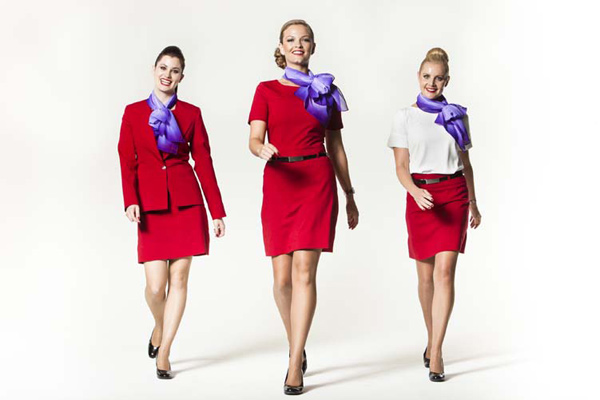
As I was now wearing my VSG, instead of seeing a robotic Flight Attendant, I only saw an attractive young blonde woman wearing a red Virgin uniform with bright red lipstick. However, the woman passenger in seat 4B saw a different image. She saw a young, dark haired, rather muscular male Flight Attendant wearing tight trousers and an equally tight fitting shirt. Yes, in case you were wondering, we were both looking at the same robot.

Now this is the rather special characteristic associated with the VSG. They provide the wearer with a fictional person that complements the particular mood that they are in at that specific time of the day. If I, or the woman sitting in seat 4B, had have caught an earlier flight, the Flight Attendant image we would have been presented with in our VSG would have been completely different. This is the charm of the VSG, each flying experience is unique and varied.

From the perspective of the airline, they can utilise the services of a cost effective, bland, inanimate, ugly looking, metallic robot to do all the mundane inflight activities. However, the VSG passengers, only observe the Flight Attendant of the dreams!

The result is a well behaved and exceptionally polite group of passengers, as no passenger wants to upset, or offend their special Flight Attendant!

So next time you are flying on a Virgin Australia plane and you receive a friendly wink from the Flight Attendant, don’t think about the gesture too emotionally, as you may be rather disappointed once you have removed your VSG. And in case you were wondering, the VSG only works on the plane, you can’t take them home and try them out on some non-robotic, unsuspecting individual!

Note: If only this wasn’t fiction!

Me, Myself and “I”

Sonrisa ante el espejo

I” opened the door and peered into the “private lounge room” where all the other “I”s were already seated. Like “me”, they all had that look of exhaustion on “their” faces. “We” had obviously all had a long, tough and quite demanding day observing “ourselves”.

Many of the “I”s sat in “their” favourite comfy leather chair with “their” heads supported in “their” hands. Glasses of spirited drinks were being sombrely consumed in an attempt to liven up the mood of the collective “us”, but with little avail, it was obviously time to verbally out pour and share the critical mirrored views of “us”.

Each “I” in turn then shared how each of the original version of “them” had performed during the day with our family, work colleagues and socially. Yes, it was a communal reflective 360 feedback session in which all the “I”s gave constructive feedback on “themselves” for the mutual benefit of the individual they represented.

Now you may be asking, “What is Steven Cramer talking about this time”? Well, what if each of us had a hidden personality called “I” that watched and took notes on how we behaved during the day? Whilst we were sleeping, these “I”s then vacated our body and met up in that “private lounge room” with all the other “I”s that we came into contact during that day. The collective “I”s would then provide feedback on what we did well, what needed improvement, or what should be quickly purged from our personality so as to avoid a repeat negative occurrence! Armed with this reflective information, our “I” would then return to our body in the early hours of the morning and have a “good chat” with “ourselves”. The following day, we would subconsciously implement what the “I” had learnt and our personalities and people skills would reap the reward from this “I” effort.

Now I can hear you all saying that this is only fantasy! But is it? Next time you are half asleep and you “think” that you feel a small part of you quickly dashing out the bedroom door, don’t be alarmed, it’s just your “I” heading out for a night of social “I”nteraction.

The Chair of Accumulated Thought

Untitled

Imagine this…located in one of the most innovative corporate organizations, whose name I won’t mention as you all know the company, there is a particular chair located in a quiet room located in the north west corner of the building.

Now this chair is quite unassuming. It is a hazelnut coloured leather chair, that is well worn and has some deep indentations from a large number of bottoms residing for extended periods of time as they enjoyed the comfortable sitting experience.

The uniqueness of this chair is that each occupant leaves a thought impression behind them that is absorbed and read by the next and subsequent beneficiaries who have the good fortune to sit in it.

This chair, also known within this corporate company as the “chair of accumulated thought” is used to derive and develop new innovations related to products and processes.

So how does it work? Well, it’s a bit like “walking in someone else’s shoes”. Once you have true empathy, you are able to view issues from another person’s perspective and this new and stimulating knowledge can be used to provide you with a completely different insight into solving a particular issue you may be facing. The brilliance of the “chair of accumulated thought” is that the empathetic experiences compound upon each other thereby providing a complex and truly original solution to any problem that could not simply be solved alone by any individual.

Yes, you are right, the “chair of accumulated thought” does not actually exist. But, it could quite easily if we shared our experiences and thoughts openly and freely with each other when trying to solve a problem. In many situations, our own personal prejudices and self-doubts limit or hinder our ideas that tend to lead to a less than optimum solution being achieved.

So next time you are solving a complex problem, or trying to develop that spark of thought innovation, why not try to utilise the “chair of accumulated thought”. May I suggest you take it in turn to actually sit in a chair by yourself and write down your thoughts in a writing pad strategically placed on the arm of the chair. The next person who sits in the chair, then reads your thoughts of prose, quietly absorbs your thinking and then adds their ideas on the page under yours. This process continues until all your colleagues assigned to solve the problem have had the opportunity to sit and write in the chair. It would be rather interesting to read the words accumulated at the end? Who knows what creative thought solutions may permeate from the activity!!

Vanilla Flavoured Diversity

My Primary Workhorse

Signed……Steven Cramer. The black ink that had just permeated from my treasured fountain pen was almost dry on my new employment contract. I gleefully looked once again at the document, and then with an eager and expectant smile on my face, I carefully folded the paper, placed it in the reply-paid envelope and put it aside ready to be posted to my new employer.

All of us have at some stage in our working careers have experienced the excitement associated with starting a job with a new corporate organization, or a new role within your existing company. Prior to us starting this new role, we have many ideas and thoughts on how and what we are going to achieve, we do not impose any limitations, nor do we expect the organization or our fellow colleagues to hamper any progress on the attainment of these objectives.

Unfortunately, many of us after a few years working for the same organization lose this positive and creative persona and slowly morph into a common and accepted form of corporate behaviour where any diversity of thought is progressively extinguished. The result is a “vanilla flavoured” corporate culture that is prevalent in many corporate company’s today.

But does this need to be the case?

A thought.
Why do we not ask all new employees to write down their career aspirations on what they would like to achieve prior to the first day of their employment? This untainted document could then be stored for a period of time (say 3-5 years) following which it is then opened and reread by the employee and discussed with a senior member of the management team. It would be interesting for the employee to see how their enthusiasm has been maintained or even increased over the time period, or has it been severely hindered? If the latter, then what has caused this negativity and how could the corporate culture be improved to encourage and foster a greater diversity of thought?

Many companies talk about the concept of diversity, but are quite content to operate in the “vanilla flavoured” business environment. When a new employee starts, they may be flavoured “strawberry, blueberry, or even have lumps of chocolate” diffusing through their personality. But after a period of time, this creative flavour may have been slowly purged and replaced with the approved corporate taste. If an organization truly values diversity, why focus on the attainment of the “vanilla”?

There are many great benefits to a company if their employees do think that little bit differently, particularly with respect to innovation which could be utilised in a variety of different areas such as new product development, improvements in service offering or potential business expansions outside the traditional norm? If all employees think the same way (“vanilla”), then opportunities for innovation and creativity will be severely restricted.

So next time you are about to start a new role, may I suggest that you capture your thoughts and aspirations and revisit them later in your working career. The rereading might be quite enlightening, particularly for you, and your organization?

The Diary of Thoughts and Questions

Journal

When you start a role with a new organization, you typically observe and learn from your immediate colleagues so you can quickly gain an appreciation of how things need to be done. During this process, you are flooded with a broad range of different ideas and processes, including the business culture.

Your mind is continually questioning and exploring potentially better ways to perform your new role. However, most new employees do not raise these new ideas owing to their short time period in the business.

After a few months, the new employee has settled in to their role and is happily following the old and well used and established processes that they were taught by their manager or work colleagues.

But what happened to all the ideas that they observed in the early stages of their employment? These valuable challenging “thoughts and questions” are key to driving change in the organization so it continues to develop and improve!

One solution is to capture all these ideas in the “Diary of Thoughts and Questions”.

This diary would be completed by the new employee at the end of each work day for the first few weeks of their employment. At the end of this time, the diary contents would then be discussed with their manager, and their boss, to explore how the potential improvements could be implemented. For the process to work effectively, all readers of the diary would need to have an open mind and be prepared to consider all “thoughts and questions” whether they be positive or negative.

Consider the FONT

Font Bureau002

Do you recall when you first learnt to hand write at school with a pencil, pen, or even a fountain pen?

I can recall spending many hours practicing to get the lettering perfect with the right loop, size, angle, colour, all of which lead to the formation of a unique writing style which became a part of my character and personality.

However, these days we all write our E-mails, presentations and documents on the computer with a common font, colour and format. This might be fine for business consistency, but why not elect to explore some different and unusual fonts which you change on a regular basis? Those reading your correspondence will notice the difference, it may also result in them thinking just that little bit differently themselves and they may even adopt your creative approach in communication?

So before you start your next E-mail…..first consider the FONT and claim your own little bit of creativity rebellion!