The Gingerbread People

Happy Biscuit

The freshly baked gingerbread men and women with an impressive and distinctive corporate logo stamped across their chest were carefully placed on each employee’s desk in the early hours of the morning. It was the last day of work before Xmas and the department manager had spent many hours tirelessly baking that morning in preparation for the annual ritual of gingerbread person desk placement.

The time was now 6 AM and with the task of distribution completed, he decided to find a quiet corporate sick-bay bed and have a couple of hours sleep before his fellow employees arrived in the office to gleefully devour their eagerly anticipated baked gourmet morsels with an accompanying cup of coffee or tea.

But this year, something rather different and decidedly odd occurred. At about 6:15 AM there was a discreet, yet distinctive, sound of pastry movement. Yes, on some of the poorly lit office desks, an occasional little gingerbread arm and foot was beginning to display some rather unique humanistic characteristics. But not all gingerbread people sprung to life?

At 6:30 AM, some baked people of gingerbread DNA were leaping and gesticulating with extensive social skills and were having a great time getting to know each other and exchanging various bodily crumbs. However, some of their other baked relatives were just lying there in a motionless state, whilst others were still experiencing the joy of minimal hand movement with no prospect of running amuck!

Just before the department manager took his last snuff of slumbered bliss signalling that it was time to awake, an internal motion ceasing sensor was triggered in each of the gingerbread people and those that were mobile all dropped down on the spot and once again became just a baked stationary figurine.

As the employees started to arrive at their desks, some were greeted with a large number of scrumptious gingerbread people. Many of the staff found a single gingerbread person on their desk in the exact same position that it has been placed by the manager, others, found none at all. So, the question that you are all thinking is, why do some people have more gingerbread than others? The answer is fairly obvious if you have studied the traits of gingerbread culture and society, but if you do not have this educational knowledge, let me explain.

It all has to do with the energy and creativity that is exhibited by those employees in your corporate office that are innovative. These people are the lifeblood of your organization and they stimulate and encourage all sorts of ideas and inspirational thinking that some of you may think is a little bit way out. But, without these people, there is no imagination, and no hope that fictional ideas such as gingerbread people coming to life could ever exist. So it is really any wonder why the gingerbread people flocked to these people’s desks?

When next you are fortunate enough to hold a gingerbread person, prior to that first chomp of delight, may I suggest you stop and think and question yourself about your level of innovation and whether your personality entitles you to eat just one, or maybe more?

The “Jane Award”

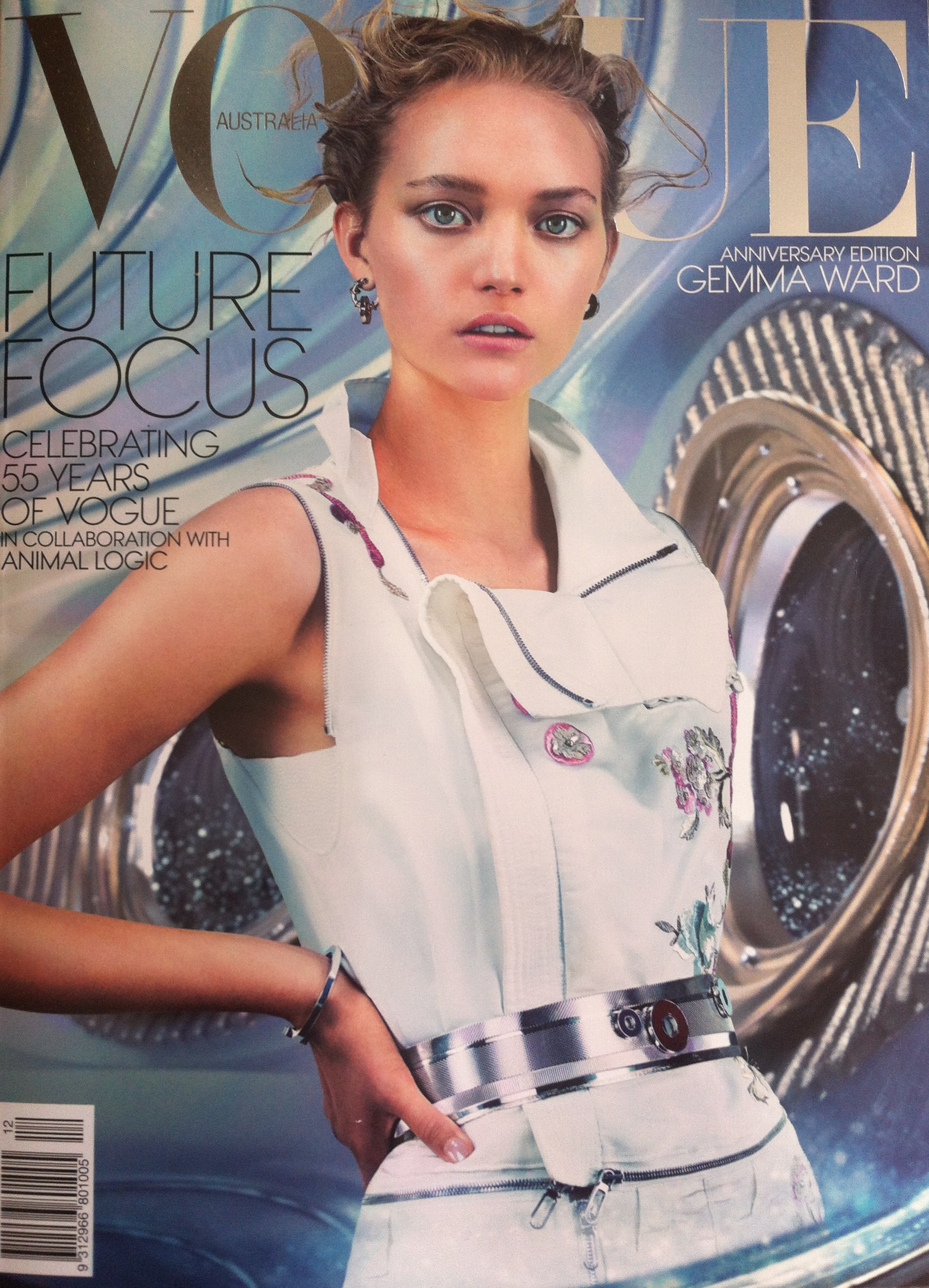
Vogue

“Not again!”, I said as the camera flashes went off in unison leading to yet another ritual of blinding light in the office meeting room. It was becoming an all too familiar event, but it was one that we all relished with eager anticipation, afterall, she is a celebrity.

She did look rather stunning I thought to myself, in her chic white business attire, but she deserves the attention. It was also really inspiring seeing her on the cover of the December edition of Vogue* magazine.

However, what I loved the most about her, was that she still just accepted her usual position in the organization and went about her duties without any fuss or change in attitude or demeanor. One day, I just hope I get to be like her and the many others in the company that have achieved her lofty status.

Her business card says it all and our company utilises these rare and key employees to their maximum potential. After all, without these critical staff, we wouldn’t be enjoying the business success that we have now all become accustomed to on a daily occurrence.

What, you didn’t get a chance to read her business card? My apologies let me hand it over and read it to you. Her name is Jane Brown, her job title is “Creative Thinker”.

Yes……”Creative Thinker”.

So what exactly does Jane Brown do, you may ask? Well, Jane, and the other employees just like her, are allowed to…..think. They are provided time in their job routine to contemplate new ideas and solutions for the business. They are encouraged to network with their work colleagues, to talk to other organizations, to share thoughts and to develop other left field, non-work related dissertations. Ideas related to the future needs of the business are strongly encouraged; in fact, they are demanded by our senior management.

So why is Jane on the cover of Vogue* you may ask? Simple, the process of innovation has no boundaries and can be utilised in all activities that we do, in this instance, Jane is seen as a role model to encourage everyone to think just that little bit differently.

I’m sure that your organization has many people just like “Jane”. These people should be recognised and applauded for their creativity. Who knows, it might just lead to the instigation of the “Jane Awards” in your corporate work environment?

*Yes, Edwina McCann (Editor-In-Chief, Vogue Australia), this is fiction, Jane Brown is not a real person, but just image if she was!!

Macabre Murderer of Marketing

Murder

The senior manager sat down exhausted in his large corporate black leather desk chair. The worn fabric felt so cool and relaxing as it snugged his body in a welcoming and inviting manner as it had done for the past thirty-five years.

He wiped the sweat from his forehead with his ragged company monogrammed handkerchief and looked at his hands now shaking with fear, thankfully he had achieved his objective before any “damage” had been done.

He carefully took out the black bound book that had lived in solitude and secrecy in his top desk draw and entered another name under the vast array of other recalcitrant employees that he had quietly “murdered” from a career perspective.

Yes, that was a close one he thought. If he hadn’t have acted, that employee might actually have changed the corporate status quo and may have injected some marketing creativity and innovation into the business. We can’t have that! But it was getting harder and harder to stop these employees infiltrating the company. He was also wondering what would happen when he retired at the end of the year. He was now despondent as he couldn’t find other younger employees that had the same unique business insight as him, nor his perceived flair of maintaining the existing corporate culture.

Mmmm, you might be thinking to yourself, as you may have already allocated a name to this senior manager in your business? If so, may I suggest that you publicly ‘call the behaviour” of these archaic and sorry individuals and lobby support amongst your colleagues to raise up a corporate mutiny for the long term betterment of your company! Don’t let this negative and destructive behaviour go unchallenged to avoid anymore creative casualties!

Sounds rather melodramatic doesn’t it? However, without creativity, innovation and marketing, it is the organisation as a whole that is suffocated as it loses the requisite lifeblood to ensure its longer term success and survival. May I suggest you don’t let this happen to yours, and if you see the signs of this occurring, try and quickly nip this potential “murder” in the corporate bud before it takes hold.

Just a thought to make you think that little bit differently.

Jockey Office Thoughts

Silks

The jockey adorned in an impressive satin quartered racing silk raised her white covered jodhpur pantalooned bottom above her mighty steed; her black crop was poised as she awaited the start of the race.

The masses that had come to see the great event cheered and shouted with such volume that the roar permeated throughout the racing track and the surrounding suburbs. It was so loud that those with hearing aids had to reduce the receptivity for fear of blowing the last remaining remnants of their fragile eardrums! The charming ladies looked absolutely gorgeous in their fashionable dresses and fancy stylish array of hats. The gentlemen all dressed in suits and bright ties complemented the occasion and looked quite spiffy. It was going to be a grand day out!

Once the race started, the booming announcer’s voice kept those punters informed on the status of their various Castillo boot cladded jockey as they competitively galloped in a rather uncomfortable looking postured position up high on their horses towards the winning post. For the winning jockey, the crowd would go wild, a voluminous frenzy would erupt and it was party time!

According to a “prominent blog writer”, a question now needs to be asked, and that is; “Why do such grand occasions not occur in the corporate office”? Why is it that when a new innovation is being developed, those employees working on it tend to sulk around the office in a mode of stealth. Is it for fear of failure, or perhaps that new innovations are not that exciting and interfere with the normal day-to-day business activities?

A “prominent blog writer” postulates that innovation should be greatly publicised within the corporate office. It should have the same sense of occasion and festivity associated with an important horse race. Those working on the innovation should be given a high profile and their progress broadcasted throughout the organization so all employees can feel part of the process of creativity and celebrate that winning feeling once the product/service is commercialised. So how do we do this? The key is communication and a function that lends itself nicely to those within your Corporate Affairs and Marketing teams. A “buzz of excitement” needs to be created and maintained along the innovation journey.

By the way, in case you are wondering, that “prominent blog writer” does not suggest that those members of the innovation teams should wear white jodhpur pants and silk shirts (OK, maybe the shirts, but definitely not the jodhpurs!), but it would make them a lot more visible within the organization?

Hair Cut Frizz

Kathy (Frizzy Hair)

My friend spent many hours and dollars sitting in the hairdresser’s chair in the pursuit of that “just right look”. Her hair was washed, cut, coloured, styled and other things I have no idea about (my hairstyle has not required a visit to the barber for quite a few years) and the final result was “hair perfection”. She looked gorgeous, but more importantly, she felt fantastic and her mood exuded confidence and that killer professional personality of “look out world, don’t mess with me!”

But, on leaving the hairdresser, the heavens opened up and a massive downpour of heavy rain engulfed her magnificent locks of hair. The result, an unexpected frizzy hairdo, and one that no longer looked the same as it did a mere one minute ago.

Now my friend could have reacted two ways:

1. Complete emotional devastation with a flurry on large tears, cursing and screams of disappointment and anger.
2. A “WTF” attitude where she enjoyed the moment whilst it lasted, but now was wondering what benefits would be achieved from her completely different bohemian and rather artistic appearance?

In the corporate world, this experience typifies the influence of a “Change Management” program on the employee. In many instances, the “Change” is totally unexpected, has caught them off-guard and they had no desire to participate. The employee, like my friend, could respond in two ways; complete emotional devastation, or seize the change opportunity and move forward with a positive attitude.

The key is to have the latter, but to do this; the whole corporate organization needs to be fully aligned in the process. Those directly influenced by the “Change” need to be supported and nurtured so they receive consistent supportive signals of encouragement from their colleagues and management. For example, with the “frizzy hair look”, here the organization would need to promote and publicly value the skills associated with a bohemian and creative attitude. If the business still wanted the “pre-rained look”, then the employee would feel ostracised and may eventually leave the company as they perceived themselves as not fitting in to the required organizational culture.

There are many potential learnings for the HR Team from this “frizzy hair” analogy, the most important one being the environment the business establishes to accommodate and support those employees influenced by the “Change” that they have initiated. Frequently, employees are condemned for not coping with “Change”, but rather it is the fault of the organization for not fully anticipating their employee’s demands and needs as a result of the “Change”.

One final question for you to ponder a little bit further. For those of us with no hair, does this mean that we can cope with change easier than other employees?

It’s all about Passion!

Passion Lives Here ...

That “P-word” is so obvious in some companies that when you walk into their corporate office foyer, you don’t need a dictionary to understand how to spell it, nor a thesaurus to interpret what it means, you can just sense and feel it. Yes, that “P-word” is “Passion”.

No, I’m not talking that form of “passion” where you see employees drooling over each other in lustful scenarios that may embarrass the observer. I’m referring to that enthusiastic and contagious behaviour that permeates within an organization that has that right mix of employee engagement and a personal and committed belief in the future growth of the business.

In the September 2014 edition of The Australian Financial Review “Boss” Magazine, there is an article that lists “The Best Places to Work”. As you read about each of these top 25 companies, the word “passion” is very apparent and is a consistent underlying theme in all of them.

So, how does one achieve “passion” in business? To me, it’s quite simple. Forget all your HR and other detailed analyses of employee engagement strategy pontification, let’s just focus on the basics.

According to the Free Dictionary (http://www.thefreedictionary.com/passion):
Passion: A powerful emotion, such as love, joy, hatred, or anger

The key in this definition are the words “powerful emotion”. When you are really passionate about someone, your have an intense and powerful desire to be with them, to see them, to have them continually in your life. The experience benefits you and you want more and more of the encounter. It is a bit like a drug that you want to continually consume.

Unfortunately, many employees don’t have any passion in their jobs and want to get out of the office as quickly as possible. So who is the blame for this passion abstinence? No, in the majority of cases it’s not the employee, but the employer.

Most corporate organizations have the best intentions in trying to motivate and inspire their employees. However, employees seem to have an inbuilt “Bollocks Meter” that measures whether the senior management team are sincere, walking the talk, or just going through the motions with yet another passing fad that will soon diminish with time.

Corporate passion can’t be bought. It needs to be lived and exemplified in all activities of the business. The passion crux is when employees want to be at work as they believe that it benefits their own well-being, those around them, and their customers. If the business is just transactional, then passion has minimal hope in succeeding.

Yes…..it’s all about the passion!

The Flamboyee

Mondrian dress

If you have ever watched a speedboat cutting through the still water in a large lake, it is a most impressive sight. Besides the monstrous noise catapulting flamboyantly into the surrounding air, in its trail there is a sharp and distinctive series of oscillating waves that permeate from the back of the boat and eventually make their way to the shore. As an observer, you have no option but to take notice and to acknowledge the visual spectacle that is quickly unfolding before your physical senses.

This occurrence got me thinking…..

Corporate innovation needs “The Flamboyant Employee” to act as a catalyst to inspire and to make others in the office think that little bit differently. As a suggestion, let’s call these people the “Flamboyee”.

As the “Flamboyee” wanders through the office, their profile captures the attention of their fellow workers. They may have a flirtatious smile, a wicked glint in their eye, wear a range of unique clothes, or possess some other individual and distinctive mannerisms and attributes. The key requirement is that people take notice of the “Flamboyee”, break their concentration and initiate a spark of innovation in their thinking, or in their subconscious. This “Flamboyee Effect” rippling throughout the office environment can be likened to the waves in the lake generated by the speedboat. Those employees in direct contact with the “Flamboyee” will tend to obtain the greatest innovation benefit.

It is important not to have too many “Flamboyees” meandering the corporate passageways; otherwise there could be a clashing of the innovation waves that may lead to a negative impact and eventual capsizing in creativity. However, a well-planned timetable of “Flamboyee” activity is essential to ensure that a sustained level of innovation buoyancy is maintained throughout the working day, particularly near 5 PM when many a worker’s motivation starts to quickly subside.

The role of the “Flamboyee” should be prized by management, and HR should have a specific position description prescribed with key performance innovation indicators to make sure that the “Flamboyee” is operating effectively and achieving their maximum creative potential.

Just a thought, but one definitely worthwhile exploring further!

The need for more noisy hot air!

Hot air Balloons

Yesterday, my early morning predawn walk of individual thought solitude was rudely interrupted by the sound of a large whooshing sound overhead!

On looking upwards, I sighted an impressive and colourful hot air balloon meandering through the clouds with a crew of delighted occupants peering over the edge of the basket gleefully looking down at me.

I became enthralled with the upward view as I listened to the random bursts of hot air blasts that the pilot used to reposition the balloon strategically in the sky. As the hot air balloon climbed to greater heights, I lost sight of it momentarily in between visual and audible “trackers” associated with the gas burner used to replenish the heated air.

The thought of these “trackers” I found interesting from a business perspective, particularly for those companies involved in the implementation of Change Management. During a time of structural change, employees need to have a reference point which reconfirms that progress is being made within the organization. In the case of the hot air balloon that was camouflaged within the clouds, these were the sounds and sights of the gas burner that punctuated its progress. In the business world, these “sight and sound trackers” could come in a variety of forms such as; financial targets, management forums, employee surveys, morale or via other external measures. The key is to have these “trackers”, and to promote them regularly as the Change Management “hot air balloon” travels towards the desired end goal (or “landing position”).

So for all you who are involved in piloting your Change Management process……make sure you make lots of noisy hot air!


The “Doer People”

How the office will look like - North Angle

On the first day with any new organisation you are provided with an obligatory induction tour of the office building that highlights all the important items such as; the location of fire exits, bathrooms, canteen, photocopier and where to park your car.

This is good……but, I’m of the view that these tours omit one of the most important and practical aspects of the building that you need to quickly know to do your new job efficiently and productively……that of the “doer people”.

So who and what are “doer people”? These are people in the organisation that have been identified unofficially by their peers as the person you should ask when you need to quickly get something done “outside” the official corporate policy. For example:

“The IT Doer Person”
Should you encounter a problem with your computer, the official work procedure is to call your Help Desk. However, if you don’t have hours of spare time to sit on hold listening to some uninspiring feeble music, or a repeating corporate message before you are eventually told to turn your computer off and then restart it, you would alternatively approach your “The IT Doer Person. This person thrives on fixing computer related problems, are typically named Boris and will fix the problem through some unfathomable means that you will never have a hope in understanding, but who cares as it takes them only a few minutes and you will then be back to work!

“The Photocopier Fixer Doer Person”
You have all experienced the dreaded “beep” noise on the photocopier when you are in a hurry to print an important document. You could quickly solve the problem if you had a Masters Degree in Electrical Engineering, but you don’t and those who do have this qualification normally run in the opposite direction on hearing the “beep” so not to be disturbed. The solution is to quickly seek advice from your friendly “Photocopier Fixer Doer Person” who thrives on solving these electronic print problems with the same degree of enthusiasm as that famous Belgian detective Poirot solves many an English murder!

“The Coffee Connoisseur Doer Person”
You could partake of the instant coffee in the office canteen if your taste buds are nonexistent, or, you could seek out “The Coffee Connoisseur Doer Person”. This person typically has a thick black book containing many coffee stained pages listing all the best coffee shops in a short walking distance from the office. These people have a privileged position in the office and are at times of caffeine lack more respected than the CEO.

I’m sure that you can list numerous other strategic “doer persons” that could complement the above three “doers”.

These people are a rare and uniquely talented individual and one that should be a compulsory inclusion in any induction tour!