Wink to the Rhythm

wiggity wizzink bw

Woohooo, there was only two minutes to go!

You could sense the air of anticipation as everyone was starting to psych themselves up for it! As the seconds counted down, people were trying to hurriedly conclude their phone conversations, meetings were quickly ending and there was a mass movement of excited employees all racing back their desks in order to get there in time. I was no exception as I looked down at the clock on my computer screen and saw that it was now 1:59 PM, only one more minute to wait!

Then at precisely 2:00 PM, with all the office staff now quietly seated at their allocated desk positions, it started.

The PA system crackled and the countdown began….5, 4, 3, 2, 1. On reaching the eagerly awaited number 1, the “gym workout music” loudly blurted out throughout the building with a rhythm of exactly 150 beats per minute.

As my desk was situated to the extreme left of the building, it was my allocated task to start the “Mexican Wave of Wink”. I turned my head to Melissa (the colleague on my right) and winked my right eye and smiled. Immediately, Melissa winked her left eye in time to the beat, then quickly turned her head to face Jules (seated on her right) and winked her right eye with perfect musical synergy, together with a the requisite beaming smile. This process continued in time to the beat until all 153 employees had winked and smiled. On reaching Peter, who was seated at the extreme right of the building, his timely wink initiated the “wink rebound” back along the “wink-chain” until I was able to receive the wink with my opposite eye. Gleeful and spontaneous laughter prevailed, as it was a unique sight to behold and a great opener to the daily 2:00 PM ritual.

My next task was to pass the “K-card”, once again in time to the beat, to Melissa, who handed it to Jules, and the process again continued. At the same time, Peter spun around once in his desk chair and stood up, thereby signalling to Angus (sitting on his left), to spin and stand up, again the process continued, until the music beat randomly stopped. The person in possession of the “K-card” now had to do some solo “krumping” for 5 seconds, following which the beat would start up again signalling the continuation of the “K-card” passing and chair spinning/standing.

Ten minutes later, the beat stopped. All employees now returned to work.

However, there was a noticeable “buzz” permeating throughout the corporate office. Motivation, employee concentration, and a most recognizable feeling of fun and teamwork prevailed.


The Office Revolution

Boldly Masculine Design

The alarm bell screeched with maximum volume! The Manager’s heartbeat immediately started to pound loudly as this was the first time that she had heard the sound, after all, it had never actually gone off before….ever! Other Managers around her also started to run around in a panic as they too had no idea what to do. The worried Managers huddled together as they quickly searched through their book of corporate policies and procedures. Finally, on page 272, there they found the answer. It was a “non-conformity” alarm! But how was it activated, and how do they stop this continual noise permeating through their normally quiet office floor?

Unbeknownst to the Managers, one of their employees had decided to mount a personal revolt!

Let’s go back to 8:30 AM that morning to understand the origin of this mystery!

Employee number 468136, aka Bernard Smith, arrived at his allocated work station. His desk was the same as every other desk on his office floor. It was white, immaculately tidy, a computer placed centrally, 4 piles of primary coloured folders on the left side, and had a standard black chair with his name branded on the back. Bernard was dressed in his black suit, white shirt and company embellished logo tie, just like all his fellow male workers.

At precisely 8:31 AM, each employee started to type on their computer and the day commenced just like every other day. However, at 8:32 AM, Bernard stopped work. He looked up and down the line of desks, each positioned in a perfectly straight line so as to not break the red laser beam, and thought…..”enough”, as a bead of sweat slowly rolled down his forehead.

To the amazement of those sitting around him, he took off his tie and undid the top button of his business shirt. Silence and an uneasy feeling quickly started to prevail. Bernard had taken the first step to his creative freedom and it felt good! As his confidence increased, he messed up his 4 folder piles. Then he did something completely radical, he moved his desk over the laser line and turned it by a full 180 degrees. He was now facing into the office, rather than a wall!

Little did Bernard know that once his newly re-positioned desk broke the red laser beam, an alarm would be triggered……

The Managers now knew the cause of the alarm and initiated an immediate and successful remedy. They decided to quickly reconfigure all work desks with Bernard’s new alignment so each and every desk now faced inwards. Once again quietness was instilled in the office as all desks now looked precisely the same as all the others. As the week progressed, the bewildered employees slowly got used to their new desk view until normality once again was achieved.

But not for Bernard, he still had no tie around his neck and there was no way he was going back to that form of corporate fashion control. He liked his messy folder pile and the air movement around his uncollared neck. It was time for revolution……!!

Me, Myself and “I”

Sonrisa ante el espejo

I” opened the door and peered into the “private lounge room” where all the other “I”s were already seated. Like “me”, they all had that look of exhaustion on “their” faces. “We” had obviously all had a long, tough and quite demanding day observing “ourselves”.

Many of the “I”s sat in “their” favourite comfy leather chair with “their” heads supported in “their” hands. Glasses of spirited drinks were being sombrely consumed in an attempt to liven up the mood of the collective “us”, but with little avail, it was obviously time to verbally out pour and share the critical mirrored views of “us”.

Each “I” in turn then shared how each of the original version of “them” had performed during the day with our family, work colleagues and socially. Yes, it was a communal reflective 360 feedback session in which all the “I”s gave constructive feedback on “themselves” for the mutual benefit of the individual they represented.

Now you may be asking, “What is Steven Cramer talking about this time”? Well, what if each of us had a hidden personality called “I” that watched and took notes on how we behaved during the day? Whilst we were sleeping, these “I”s then vacated our body and met up in that “private lounge room” with all the other “I”s that we came into contact during that day. The collective “I”s would then provide feedback on what we did well, what needed improvement, or what should be quickly purged from our personality so as to avoid a repeat negative occurrence! Armed with this reflective information, our “I” would then return to our body in the early hours of the morning and have a “good chat” with “ourselves”. The following day, we would subconsciously implement what the “I” had learnt and our personalities and people skills would reap the reward from this “I” effort.

Now I can hear you all saying that this is only fantasy! But is it? Next time you are half asleep and you “think” that you feel a small part of you quickly dashing out the bedroom door, don’t be alarmed, it’s just your “I” heading out for a night of social “I”nteraction.

Corporate Dress Design with “Wind Gust Resistance”!

Wind Gust

“There must be a solution!”, I thought to myself as I was walking in the Sydney CBD this afternoon and saw yet another corporately dressed woman holding her skirt as she fought off those all too frequent wind gusts!

For too long, women have had to endure the public embarrassment associated with unwanted underwear exposure!

So as I walked, I pondered some potential ideas to alleviate the occurrence. Now, there does need to be a self-imposed caveat here, mainly because I haven’t experienced that dreaded moment of dress wind gust movement, so I can only speculate as to the impact.

If you are a fashion designer reading this blog post, please don’t laugh too loudly! However, it may just spark an idea in your minds that might actually make some sort dress design sense? But, then again?

Design Option 1: Underwear Hip Magnets
Now this is a design that would need to be tested first to ensure that womanly comfort is not compromised! The big feature of this concept is its simplicity.
In the skirt there would be a hidden interior pocket strategically placed next to the left and right hips. Should the weather look likely that a wind gust may eventuate; the dress wearer would quickly place a metal disc in the dress pockets. At the same time, a smooth edged, very flat magnet, would be placed into the elastic underwear waist band thereby locking the skirt into position.

Design Option 2: Waistband
Sewn into each dress waistband there could be 5 equally spaced $2 coins which are held in place by a discreetly hidden placed zipper. When the wind gust eventuates, the zip is opened and the coins fall into an inner sleeve positioned in the hem of the skirt thus eliminating skirt flap.
Alternative benefit: should the dress wearer need some money for any unplanned items (such car parking or restaurant tips), there would be an ample supply that could be quickly utilized when required?

iPhone App:
Although not a dress design option, an iPhone App could also be developed that monitors wind gust velocity in the city thereby providing an early warning for the use of the above Design Options?

Now for all you kilt wearers, sorry, I have no idea!

Hopefully, unpredictable dress wind gusts will soon be a thing of the past and all corporate dressed women will be able to walk with confidence in the city!

The Brand

IMG_0249 (1)

The Harley Davidson motorcycle hummed past me with that deep-throated gnarly musical sound. Perched aloft the seat was a rather tubby leather clad middle-aged man with a long matted grey beard. Branded across his back was a large replica of his bike’s logo to which a massive “smile” complemented his daredevil face.

A cold gust on the winter wind was thwarted in leaving in imprint on the young woman’s face by her strategically wrapped Burberry scarf. But not to be outdone by this singular and fashionable item, additional clothing with the well-known motif soon appeared to encapsulate her from any other unwanted cold forays of gust. A similar “smile” to her bike riding unknown friend also appeared across her face.

The chanting increased in volume from the crowd all fashionably mimicking each other in their blue and white horizontal striped football jumpers as they took delight in tormenting their brown and gold vertically striped opposition supporters. That “smile” was once again evident.

On walking into one particular corporate office, that “smile” of belonging was most noticeably absent. It appeared to be an office comprised of a large number of individuals all supporting their own “smile” or brand, not one of a unified and cohesive organization.

If we consider the Harley Davidson rider, the Burberry wearer, the football supporter, they all derived some “smile” benefit from their association with these brands. Some corporate organizations, such as Google, McKinsey & Co, Virgin (and many others), do instil brand loyalty and a strong desire of wanting to work there. No, an organization doesn’t need to be a well-known brand to achieve such employee motivation and commitment; similar results can also be attained from a small family business, a school or a local club. The key is in believing that you make a contribution to the progress of that organization and that you also derive some associated personal benefit in return (eg the “smile”, career, financial, friendship, etc).

If you are a CEO in your corporate office, is that “smile” evident in your employees? No, I’m not talking about that polite and courteous smile that employees always make in your presence, but that real “smile” of wanting to belong, as they believe in the organization. If it exists, fantastic! If it doesn’t, then you now have a very important New Year’s resolution for 2015?

Yes, it’s all in the Brand….

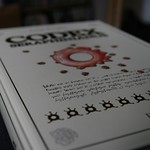
Codex Seraphinianus

The Codex Seraphinianus

Today I was reading a Twitter post by Maria Popova (http://t.co/RdK5JUZsOI) about Luigi Serafini and his encyclopaedia called “Codex Seraphinianus”. The following is the first paragraph from Maria’s post;

In 1976, Italian artist, architect, and designer Luigi Serafini, only 27 at the time, set out to create an elaborate encyclopedia of imaginary objects and creatures that fell somewhere between Edward Gorey’s cryptic alphabets, Albertus Seba’s cabinet of curiosities, the book of surrealist games, and Alice in Wonderland. What’s more, it wasn’t written in any ordinary language but in an unintelligible alphabet that appeared to be a conlang — an undertaking so complex it constitutes one of the highest feats of cryptography. It took him nearly three years to complete the project, and three more to publish it, but when it was finally released, the book — a weird and wonderful masterpiece of art and philosophical provocation on the precipice of the information age — attracted a growing following that continued to gather momentum even as the original edition went out of print.”

My first reaction on reading this was, “What a brilliant concept!”.
My second reaction was, “Why do we never see such creativity in the corporate office?”
The third reaction was, a repeat of my second reaction, “Why not?”

For a corporate organization to be innovative, it needs to be allowed to think. It’s employees need to be provided with the opportunity to have random, creative thoughts that are not inhibited in any way, but are allowed to run free.

In my blog (https://thinkingfuturethoughts.wordpress.com/) I have written many posts trying to inspire those in the corporate office to think that little bit differently. Yes, some of these posts are a little bit way out, but that’s very much the intention. A previous blog post called “The Room of Thought” typifies some of this thinking; (https://thinkingfuturethoughts.wordpress.com/2013/08/29/the-room-of-thought/)

It’s gratifying to hear that many corporate organizations are now using my blog posts as “thought starters” for their employees, but companies need to do more and strategically embed creativity into their cultural DNA. Unfortunately, for some CEOs, innovation is merely just lip service.

The concept of “Codex Seraphinianus” is a fantastic example in “thinking that little bit differently” and inspires those reading it to open and expand their imagination. It breaks all the traditional rules, which I can only applaud.

Yes, this is my first book review and I give it 4.5 out of 5. Why not 5? Well, the score of 5 has been reserved for your own version of “Codex Seraphinianus” of which you will be the author. This version will I’m sure be a creative masterpiece!

It’s all about Passion!

Passion Lives Here ...

That “P-word” is so obvious in some companies that when you walk into their corporate office foyer, you don’t need a dictionary to understand how to spell it, nor a thesaurus to interpret what it means, you can just sense and feel it. Yes, that “P-word” is “Passion”.

No, I’m not talking that form of “passion” where you see employees drooling over each other in lustful scenarios that may embarrass the observer. I’m referring to that enthusiastic and contagious behaviour that permeates within an organization that has that right mix of employee engagement and a personal and committed belief in the future growth of the business.

In the September 2014 edition of The Australian Financial Review “Boss” Magazine, there is an article that lists “The Best Places to Work”. As you read about each of these top 25 companies, the word “passion” is very apparent and is a consistent underlying theme in all of them.

So, how does one achieve “passion” in business? To me, it’s quite simple. Forget all your HR and other detailed analyses of employee engagement strategy pontification, let’s just focus on the basics.

According to the Free Dictionary (http://www.thefreedictionary.com/passion):
Passion: A powerful emotion, such as love, joy, hatred, or anger

The key in this definition are the words “powerful emotion”. When you are really passionate about someone, your have an intense and powerful desire to be with them, to see them, to have them continually in your life. The experience benefits you and you want more and more of the encounter. It is a bit like a drug that you want to continually consume.

Unfortunately, many employees don’t have any passion in their jobs and want to get out of the office as quickly as possible. So who is the blame for this passion abstinence? No, in the majority of cases it’s not the employee, but the employer.

Most corporate organizations have the best intentions in trying to motivate and inspire their employees. However, employees seem to have an inbuilt “Bollocks Meter” that measures whether the senior management team are sincere, walking the talk, or just going through the motions with yet another passing fad that will soon diminish with time.

Corporate passion can’t be bought. It needs to be lived and exemplified in all activities of the business. The passion crux is when employees want to be at work as they believe that it benefits their own well-being, those around them, and their customers. If the business is just transactional, then passion has minimal hope in succeeding.

Yes…..it’s all about the passion!

Cultural Transformation to a Tea!

Tea

I’m one of those tea drinkers that likes to have my tea in a long tall and transparent glass. There is something quite magical about observing the tealeaves gradually permeate their colour, taste and odour with the boiling clear water. With time, you will observe the tea colour swirling and leaving a distinctive trail in the water, with additional time, the tealeaves will transform the water into a uniform and translucent colour. The degree of tealeaf permeation, or transformation, can be controlled via the immersion duration time in the water.

Let’s take this analogy into the corporate office with respect to cultural transformation.

Many corporate cultures can be viewed like the glass of clear boiling water. To look externally at the glass, it is homogeneous, quite bland, and the only activity appears to be the vapour trail exuding from the top of the glass as a result of the high temperature (100C). However, unless something happens within the glass, the water will cool and the glass will reach a temperature that coincides with the surrounding room temperature. This is the boring corporate culture that is common in so many organizations today.

The key to cultural transformation is the introduction of a catalyst to initiate and drive change. However, prior to its introduction, the business management team need to identify and agree on what their unique and distinctive organizational culture needs to be? Let’s go back to the tea analogy. How will the business culture be defined? What will be its colour, taste, smell and intensity? How long will the process take to be achieved? What catalyst will be used to initiate and drive the cultural transformation? Will the employees, customers and the market like the final taste?

When tealeaves are added to the boiling water, the permeation can be accelerated via movement of the leaves, or the water itself via a stirring action. In other words, some action needs to occur to progress and maintain the transformation.

So when next you are considering the implementation of your next cultural transformation in your office, or if you are currently in the midst of one right now, may I suggest that you consider the following key elements:

1.A transparent glass enables your employees to see the degree of transformation permeation. Don’t hide the process, make it very visible.
2.Is the water hot? Is the corporate environment at the right temperature for the required cultural transformation?
3.What tea will be introduced into the water? What will be the catalyst that you will use to drive the change? What colour, taste, smell do you want to achieve that defines your corporate culture?
4.When should you introduce a spoon into the glass to stir things up a little? What stirring speed is optimum to achieve the desired effect?

Once the desired tea has been achieved, there is no point everyone just looking at it with admiration, make sure that all those involved in the transformation process drink the tea and provide management with feedback so the tea can be tweaked accordingly to maintain the optimum taste and enjoyment!

Don’t relax once you have obtained the targeted cultural transformation, as just like with tea, the organization’s tastes will change over time. Be prepared to continually experiment; maybe add some lemon, some honey, or another tea flavour to add that additional zest!

Let the Ideas In

Padlock.gif

Many corporate offices these days are starting to have a somewhat cloned appearance of the CIA, MI6, ASIO, and most other intelligence organizations, with all the security gadgets located throughout their buildings. This is evident by the increasing visibility of security cameras, sensor movement measuring devices, electronic swipe cards and other items that may have been derived from a James Bond 007 movie!

These security measures are very successful at keeping unwanted people out, and those valued people in, together with protecting the businesses intellectual property and other strategic assets. This security focus also permeates into the organization’s hierarchy and culture where only a limited number of vetted employees are allowed to represent the business in the external world to ensure consistency of message.

A major consequence of these established corporate fortresses is that many new ideas, creativity and innovations are also blocked from entering the organization. Many companies utilise a limited number of gatekeepers to filter and disseminate information inputs into the organization thereby ensuring a consistent methodology to evaluate potential opportunities in accordance with well established, and approved, corporate guidelines. However, this can result in stifling innovation and in restricting the highly needed creative thought that is essential to the longer-term and ongoing success of the organization.

The solution is for organizations to have a broad network of “idea collection systems” in place to seek out, identify and gather new thoughts that can analysed further to better understand current and future consumer trends and market requirements. The key is to allow many employees in the corporate structure, not just the chosen few, to have the opportunity to source these ideas without the use of the approved corporate filtering and distillation processes, otherwise this will again lead to a narrow view of potential innovation opportunities.

These “idea collection systems” do not need to be extremely ornate, sophisticated or expensive, but can be achieved via allowing people from a broad cross-section of the organization access to a variety of external information stimuli that they would not normally have exposure to via their traditional job roles. Examples of these “idea collection systems” could be; magazine subscriptions (HBR, The New Yorker, Food and Wine, MAD Magazine, Top Gear, etc), attending seminars, webinars, workshops, interest groups, factory tours, plays, book reviews, plus many more! The objective is creative diversity with ideas sourced from outside their current “thought zone”.

The vast array of collected ideas should then be pooled into a continually overflowing “idea bucket” from which those versed in the identification of potentially new ideas and products review on a regular basis. With time, I’m sure that this collective of numerous ideas will lead to many commercially new and innovative products being developed to provide future long-term benefit and financial sustenance to the corporate organization.

The corporate goal should be to have many employee “ears and eyes” constantly seeking new thoughts to add to the “idea collection systems”. But to do this, the corporate organization needs to be bold, to listen, and to “Let the Ideas In”!


Leading the Troops

9362723445_85b224a5a0_q

Never has the role of a leader been more critical than when an organisation is undergoing a severe dislocation derived from a Change Management program.

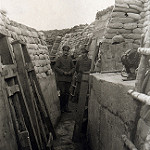
The impact on the business could possibly be likened to how a soldier’s behaviour changed when faced with trench warfare in the First World War. In the trenches the soldiers lived in constant fear of having to go over the trench wall to face a highly risky and unknown future. To an employee, the analogy is unfortunately very similar! Consider the following:

1. Casualties
The soldier was continually seeing many casualties inflicted on their comrades by the enemy (the employee experiences many of their co-workers being made redundant and lives in fear that they too may also lose their job)

2. Lack of Information
Most soldiers were kept in the dark regarding the military mission and only saw short term actions which appeared to be rather foolhardy (employees do not fully understand the end goal of the Change Management, but rather judge the progress being made by how it is impacting themselves and their immediate coworkers)

3. Rumours
A lack of regular communication and dispatches from the military command resulted in many rumours spreading amongst the troops (if there is a lack of communication from management, rumours become rife and spread quickly throughout the organisation leading to poor morale)

4. Environment
The living conditions in the trenches became intolerable and basic hygiene quickly deteriorated resulting in discontentment and potential mutiny (employees will cope with poor work conditions and uncertainty for a limited period of time, however, should this continue many employees will seek employment elsewhere).

5. Recognition
Those soldiers who exhibited extreme courage were awarded decorations of valour, such as the Victoria Cross (employee contribution should be recognised and rewarded).

The military commander needed to have the ability to inspire and motivate the troops to have the mental and physical fortitude to leave the perceived safety of the trench and to risk their lives to fight the enemy to gain a forward position.

Here the manager must also lead their fellow employees along the Change Management journey to ensure the success of the business reorganisation, otherwise the structural change process will undoubtedly fail. Employees need to believe that their individual contribution is significant and will make a purposeful contribution to the long term survival of the business.

So before you raise your “manager’s sword” and utter that famous “charge” command, make sure you have considered all the aspects associated with the life of a soldier struggling in the trenches so you taste victory instead of defeat in your Change Management activity!