Why Be a Moth?

Stop and look everywhere around you and you will observe the effects of a new sociological condition that is quickly influencing the world’s population. The malady is readily seen on individuals of all ages, regardless of their sex, and seems to have a higher concentration in cities where mobile connectivity is at its optimum receptivity. For those that reside in remote geographical locations, its influence appears to be minimal, or hardly ever seen with any noticeable detrimental consequences to the individual.

The condition has been likened to the behaviour of a moth, where the unwary insect is instinctively attracted to any bright light where its eyes are total fixated, upon which the mesmerising spell cannot be easily broken.

The culprit of this unfortunate condition has now been identified, and after numerous independent investigations one can unreservedly state that the source is the mobile phone.

Yes, the mobile phone. When this small handheld item is switched off, or is lacking electronic battery stimulation, many of its owners become quickly unsettled, lack focus, become irritable, seek inspiration, and eagerly await its rejuvenation.

Many of these mobile phone owners need the bright light permeating off their screens in order to function effectively. You will see them wandering the streets with their heads stooped down hovering intently over one of their hands angled to obtain the optimum screen viewing. The routine also applies when seated, or when trying to go to sleep in the evening.

Like a moth, many of these phone users have become so absorbed in the activities on their phone that they have walked into parked cars, become completely disorientated, or sadly killed owing to their single eyed focus.

The problem is also unfortunately seen in business, much to the detriment of productivity where the worker constantly picks up their phone looking for any sign of engagement.

Now why is this moth behaviour not observed in remote areas? The answer is simple. The mobile phone has no receptivity so there is no unwelcome distraction to illuminate and divert the eyes of the user. Remarkedly, studies of people living in these areas were found to have less detrimental psychological problems, in fact, they seemed to be better balanced and happier than their populated city counterparts.

So what does this mean for the well being of society? The answer is simple. Do you want to be a moth that regularly gets its wings singed by travelling too close to a spellbinding beam of light? Or do you want to be in control of your own life flight without the crutch of a mobile phone that continually distracts your way forward?

The choice is yours.  
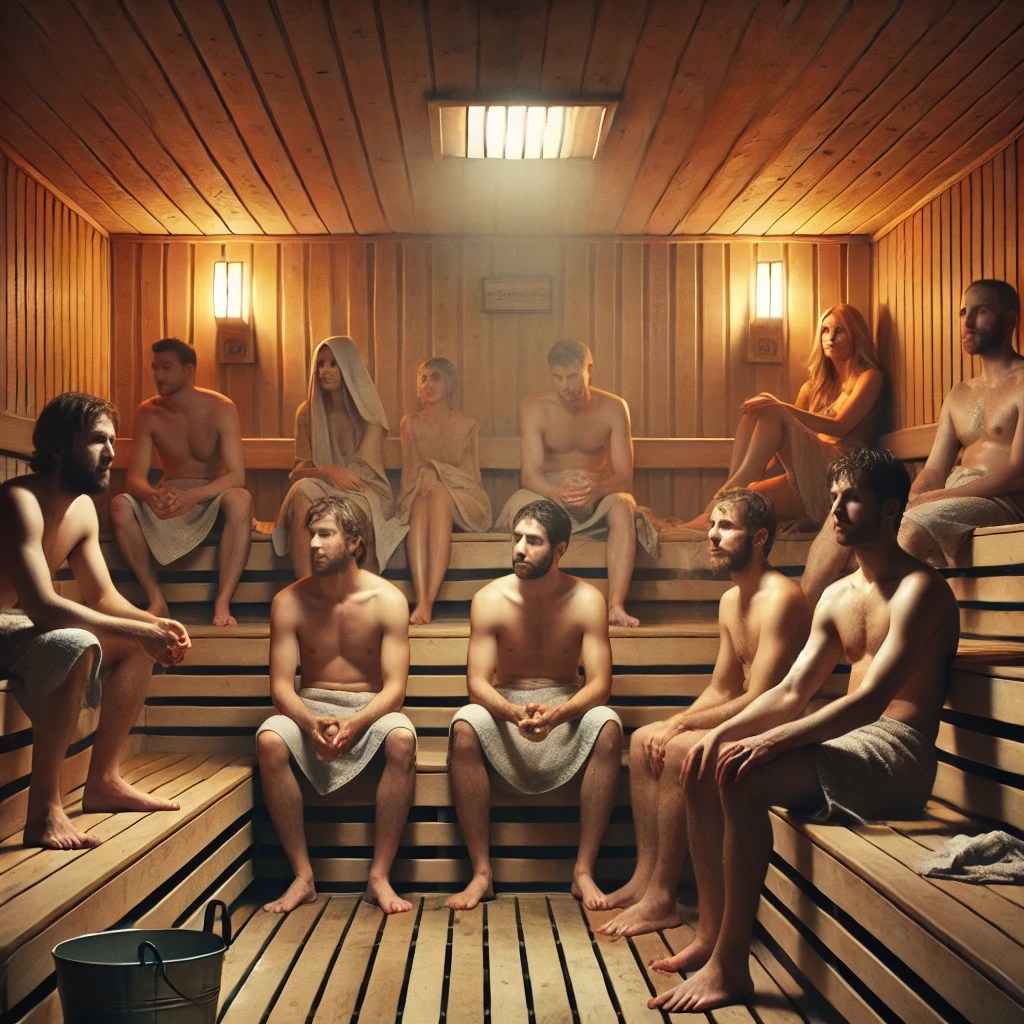
To be, or not to be, that is the Question?

It’s a visual predicament that many a novice, regardless of their age and sex, has embarrassedly faced when travelling on business.

In some European countries where public nudity prevails without the slightest battening of an eyelid, the question is, what is the acceptable norm?

After a long and tiring business flight to attend a meeting or conference, many a weary traveller will seek out a relaxing sauna at the hotel in preparation for the following busy day ahead. This may seem like a harmless activity, but many questions await those that place their hand naively on the warm condensate hotel sauna door ready to enter.

Before the door is surreptitiously opened, the question of sauna attire immediately springs to mind, that being, have I made the right choice?

Should one be wearing a towel encompassing your naked body, or should the user be equipped in a modesty covering bathing suit? A quandary of potentially awkward scenarios now prevails based on your decision.

You enter the sauna and observe that all the occupants are naked and comfortably sprawled in a very nonchalant manner without any attempt of body concealment.

Scenario 1: No Bathing Suit
Here your response is simple, walk in, take a suitable seating position and casually remove your towel. You are now claiming your role in this microcosm of European society. The key for this new found social acceptance is to act like you do this on a regular basis and are comfortable in your own, and the nudity of others.

Scenario 2: Bathing Suit
This is where things may get awkward. What do you do? Do you leave your towel tightly wrapped around your body with the intent of not showing those naked individuals in the hot and misty room that you are clothed underneath? Do you remove the towel and sit down fully clad in your bathing suit thereby exercising your right not to be naked? Or do you quietly disrobe and join in the unified and accepted state of communal nudity?

Obviously, the choice is indeed yours.

However, another question now prevails. Where does one look? I will let the reader respond to this question.

Note: This situation occurred to the author on a business trip. My response to the above scenarios and the other questions asked will remain private. But, it was interesting to meet many of the sauna occupants at the conference “officially” the following day…

Office Fretification

There is a viral condition called “Office Fretification” (otherwise known as as OfficeFret) that is sweeping the corporate world globally. I’m sure many of you have seen it and are aware of the severe negative influence it can have on others, but didn’t know it had a name, or indeed a cure.

It’s frequently observed in employees who have a psychological intolerance that flares up as soon as they’re asked to leave the comfort of their snug home abode and return to the office to work. 

The origin of this devastating malady was COVID-19 when some employees gleefully packed up their desks and became accustomed to a blissful life of working from home for long periods of time. Gone were the days of actually conversing to a real person, or having to be transparent as to their work activities. At home they could hide behind their video conferencing avatar, be busy doing their own personal machinations, like cooking, walking the dog, or having a quiet snooze. 

But alas, all that changed once the COVID-19 vaccinations started to negate the reason for their newly cherished home lifestyle and they were requested to return to the office. Upon hearing this instruction, this is when the condition of OfficeFret starts to become most evident.

The OfficeFret symptoms are easily identified:

  1. “I don’t feel well, – I need to take sick leave”. It’s remarkable how easily a medical certificate materialises to validate the claim?
  2. “It’s too noisy in the office – I need quiet to think”. Funny that with so many empty desks in the office, not one of them could be used?
  3. “I have to get my car serviced, or a fridge needs to be delivered – so I need to work from home all day”. 

As the name suggests, the employee starts to fret and begins to implement a diversionary tactic to maintain their working from home bliss.

So how does an one treat an employee suffering with OfficeFret you may ask?

No medical script is required; rather it comes in the form of a termination letter. The sufferer of this malady then has a choice, they can come into the office, or stay out permanently where they can continue with the lifestyle they have become accustomed to, but minus the salary. 

Enough is enough.

Sorry, “Operational Issues”

Those of you who fly Virgin Australia would all be aware of the frequency of flight cancellations where your departure has been delayed due to “operational issues”.

When you think Virgin Australia, what are the first two words that come immediately to mind? Yep, those dreaded words are “operational issues” that are received via an impersonal SMS letting you know your flight has been cancelled. And no, it’s not a random event, it happens regularly and is now an expected occurrence that you need to build into your travel plans.

Virgin travellers of Australia, it’s time for a flying revolt!

Unfortunately, the Star Trek technology where that famous quote of “Beam me up Scotty” does not yet exist, maybe one day, but alas, not yet. So what other options are there?

Referencing that 1972 political slogan of Gough Whitlam, yes, “It’s Time”, and that time is the fast bullet train that links the major capital cities of Australia. According to one study, it would just over 2 hours to travel from Melbourne to Sydney. Well, let’s get on with it!

“It’s Time” that Australian airlines realise that customer service is not just about moving paying passengers on a timetable that suits them, but one that actually meets the time needs of the buyer. Gosh, now wouldn’t that be nice!

What if a restaurant decided it didn’t suit them to deliver the meal that you ordered within say 30 minutes, rather it would be better owing to “operational issues” to cook and then serve up the plate 4 hours later, or even the following day? Would it be tolerated? Nope, because we have options to dine in a variety of restaurants. But this isn’t the case with Virgin or Qantas.

So let’s compare a bullet train with a Virgin flight from Melbourne to Sydney.

The Bullet TrainVirgin Australia
Leaves from the Melbourne CBD, arrives in the Sydney CBD. Is linked via public transport. Simple.Takes an hour to drive to the airport either by taxi or car (which you leave in an expensive carpark). You go through security (where you need to remove many of your clothes and other items). You wait for your plane to depart, which is never on time, or might be cancelled owing to “operational issues”
You can walk around the train, buy a drink, have some food.You are strapped into a chair, feeling like a sardine. Food (forget it).
Happy factor = highHappy factor = ask another question
“It’s Time”Say no more.

So, should anyone from the Australian Government be reading this post, don’t ignore it, but do heed the message as enough is enough. Something needs to be done, the preferred solution of “Beam me up Scotty” may occur one day, but in the interim, just focus on getting that bullet train going sooner rather than later!

Will A.I. yield the right answer?

Everywhere one looks these days, the term A.I. (Artificial Intelligence) is bound to be seen. For those that are in the know, be they academics, corporates, or maybe just like you and I, everyone has an opinion about how it will drive innovation and be the visionary oracle of future thoughts.

But I’m not sure?

Those who are believers, inform us that A.I. is indeed the acknowledged master at identifying those minute signals of information that us mere human mortals just cannot see or understand. It then cleverly invokes its phenomenal artificial brain prowess to analyse, construct and then inform us of a forthcoming trend, be it immediate, or to occur in the fullness of time.  Some of us, who will not be named, willingly accept this information without any timely critique as to its relevance or validity.

Now a question for you to ponder. If we nonchalantly accept this A.I. prediction, will this prophecy actually become a reality? In the words of Shakespeare, “For there is nothing either good or bad, but thinking makes it so.” Therefore, if we blindly accept this A.I. prediction, will our thinking make it real?

But wait. What if we provide a counter acronym, and one that is more humanly discerned than the letters A.I., that being “Almost Intelligent” (aka AL.I.)?

Let’s apply this revised concept of A.I. to two well-known and universal scenarios to test this AL.I. variant theory.

Scenario 1: Teenage Children

Many parents leave the dishwasher door open in the hope that their teenage son or daughter will pick up their dirty dinner plate and cutlery and place it diligently in the nominated kitchen equipment with minimal or no fuss. Over a period of days and even months, strategic clues are left either verbally or physically for the intended recipient. If the traditional A.I. analysis process was invoked, these parental signals may have a different interpretation, such as mess is good, dirty plates have a fashionable place on the kitchen bench, or their bedroom floors, or that parents enjoy leaving cryptic hints as part of some intriguing treasure hunt gamification.
But if the application of AL.I. is invoked, the applied combination of all these parental signals, complete with the requisite human intervention would lead to a different outcome, that being, “Put them in the dishwasher, now!”
The AL.I. analysis results are in no doubt, nor misunderstanding by any of the participants.

Using a similar theme, let’s consider Scenario 2: A Messy Desk

Yes, I acknowledge that some of us do value the benefits derived from having a messy desk, particularly as it is reported by those who reportedly know better to foster and encourage an innovative mindset. However, using the traditional version of A.I., how would it interpret these desk presented signals, and then construct a logical conclusion? Those that support the philosophy that “mess is best” know that there is no systematic methodology being used to obtain the desired visual output, rather it is perhaps based on the individual’s mood, emotion, and a somewhat random and possibly perceived lazy personal disposition that may prevail at that point, and other times, in the working day.
A.I. hasn’t got a hope in analyzing this human trait, but AL.I, when combined with our visual receptivity and knowledge of the individual involved would immediately understand what is being demonstrated by the occupier of the desk in question.

So, the conclusion is that a word of caution is most definitely required when discussing the virtues of A.I.

Hence, for those of us seeking a better, and more possibly reliable analysis technique, may I suggest that the term AL.I. be used, where the application of a little bit of human thought could greatly improve the outcome where, “thinking may not make it so, but maybe”.

Heed the Turtleneck

If you want to experience that cuddly innovative feeling in your corporate office, then simply pop your head through the neck of a fashionable turtleneck jumper and your desires of creative longing will immediately be fulfilled.

Now, for those of you that are currently a wearer of the world-famous turtleneck design, you will know exactly what I mean as you will have already grasped this cosy concept by the scruff of the knitted circular neck.

So why the turtleneck? Well, according to a soon to be published article in some obscure global publication, it’s apparently due to the ingenious design. The unique construction continuously directs and squeezes imaginative thoughts and emotions in a highly coordinated manner from the arms, chest, and other lower body regions towards the neck, and then ultimately up into the wearer’s mind. It is analogous to an “innovative thought-pump” where a rhythmic array of creative beats effortlessly proceed unhindered whilst the body-hugging jumper continues to be worn.

But alas, not all turtlenecks are the same as the colour selection acts as a creative thought catalyst for the wearer. The key is to know what colour works best for you, as the wrong choice could lead to the opposite effect where the wearer becomes passive, boring, or even ridiculed. The colour black seems to be most popular, particularly with those messy creatives as it hides and disguises an endless number of sins that are deemed by many an uneducated observer as being messy.

Another item for consideration is the number of neck rolls on your turtleneck collar. May I remind you that the jumper’s design is to forcefully pump creativity to your head, too many neck rolls may lead to a massive idea overload where the wearer may become lightheaded and eventually faint. As such, if you are a novice to this fashion accessory, the medical recommendation is to initially try a single neck roll, with time, additional rolls may be added, once proven.

Now should you be one of these turtleneck wearers with an abundance of chest hairs, be you a man, a woman, or other, there is another warning that you should heed. This is when a recalcitrant and stoic hair decides to permeate through the woven woollen fabric and nonchalantly peak through for some additional visual gratification. You and your hairs may not mind this display, but it can potentially be a little off putting for those who lack your hairy chest blessing and are quietly jealous.

So may I suggest that you unbutton your business shirts, place them back on the hanger in your wardrobe, and confidently replace them with a turtleneck jumper. Your ability to innovate will quickly prevail, and your appearance will warrant many a look of approval from your work colleagues and friends.  

It’s not about Me, it’s about We.

For those that want to be truly innovative, may I suggest that you focus on the collective and not wholly on your individual perception of what you think is brilliant. Yes, you may believe that you alone are the source of many wonderful and creative ideas, but how do you know that they actually are, unless you share them with someone else and seek their objective feedback or opinions?

To be creative, you need engagement, and ideally this should be done within the same room or space, not remotely. In fact, a recent study conducted by Stanford University indicated that face-to-face meetings generated more ideas than if the same interaction was conducted virtually. For those of you that work in a creative environment, this is yet another good reason as to why you and your fellow staff should be working in a communal office, or studio, and not from home. Put simply, physical collaboration breeds and promotes optimum creativity.

The ideas of the “Me” might seem to be good, but when combined with those of the “We” and then with the “They”, the outcome just seems to work better and is ultimately more successful.

For example, consider coffee. You may grow what you think are the world’s best coffee beans (the “Me” idea). Whether they are deemed good or bad, depends on how they compare with your competition and this is typically achieved via the process of discussion and comparison (with the “We”). Of course, you do have a choice in this decision. Should you elect not to, you will never know the outcome, but then again, you may be happy in your ignorance. But to really check the validity of the beans they need to transformed into an actual hot, steaming cup of coffee manufactured via a range of intertwined process transformations that eventually require the application of a coffee pot, water and heat (the sum being the “They”). The final test being the actual coffee consumption, but even then, people have different tastes and expectations. Although very much a simple example, it does demonstrate that ideas need to be worked and tested via interactions with the “We” and the “They”, not just based on the perceptions of the “Me”.

The COVID pandemic forced many employees to work from home, many of which are still reluctant to return to the office for a variety of practical and personal reasons. However, should you want to be at your most creative, the power of the “We” needs to be considered even though the benefits of the “Me” may seem most enchanting and persuasive.

Another factor for consideration is the ability to visually see and engage with the powerful ideation catalysts of experience and mentoring when physically situated in the office, rather than being electronically portrayed via a two dimensional image personified in a video conference. Yes, a picture can say a thousand words, but a real life interaction tells a more powerful and enriching story.

So if your objective is innovation, the answer is simple. Move past the “Me”.


2035 Business Graduation Address

It is a great honour to be looking at you all as I sit in your individual home offices virtually via hologram. For those of you that made an effort to tidy your work-spaces, wear the non-standard tracky pants and have a business-like appearance, I applaud you for trying something different and unusual.

Please note that I have turned off the odour link in this presentation. The woft of coffee from some of your living abodes is indeed most enticing, but there was a rather distinct and a tad offensive smell originating from one of you so for the sake of all those participating, you will no longer be able to access this function in the hologram conference setting.

Today is your day, so enjoy it.

As you now enter the corporate workforce where you will be asked to work at least a 15 hour week (two days in the old business language), make sure you do dedicate some time in your busy work-life schedule for actual work. I know it’s a big ask, but your employer will expect nothing less.

By comparison, when I was in your shoes (for those of you that don’t wear any, it’s a metaphor), my employer actually insisted that we work in a physical office, sitting next to real people for five nominated days per week, these being Monday to Friday. We also arrived and departed at the same time each day. I know this concept is truly foreign to you all, but there were some learnings to this rather archaic practice that you might find interesting and beneficial as you commence your business careers armed with your digital graduation certificates.

1. Working in an Office

To many off you, this will be a concept that you have only read about, or watched in old movies, but it did occur. Employees really did cohabitate in buildings for prescribed hours in the working day. There were many benefits, the main one being physical interaction where you could communicate with a co-worker, not in a virtual sense, but in real life.
Meeting rooms had four physical walls, a roof and a floor. Those encapsulated in the room entered and departed via a door. You saw the whole person, they could not be muted, or turn off their camera. Once located in the room, you had to focus on the nominated activity, you couldn’t pretend to be there, or nominate a stand-in avatar of yourself, you had to actually concentrate and participate on the meeting agenda.

2. Travelling to and from the Office

Employees literally did travel to the office. The choice of travel was left entirely to the individual, it was not mandated. This could be done via car, public transport, pedal power, or other forms of transportation. The only requisite was that you arrived and left work at a nominated time each day. By doing this, your work colleagues had the optimum opportunity for engagement.

3. Interstate and Overseas

Yes, those working on business did truly leave the office and travel to see customers, colleagues or develop and progress new relationships. In the olden days, we enjoyed face-to-face interaction, particularly when meeting someone for the first time.
The main mode of travel used was the aeroplane. There was even a section on the aircraft called “Business Class” that catered for the needs of those travelling on business, not pleasure.

4. Business Attire

This you will most likely find unbelievable, but we dressed up each day when we attended the office. There was such a thing called “corporate attire” which was typically a jacket, shirt and trousers, women occasionally wore a skirt or a dress. Now and then, men would even wear a tie, which was an expensive piece of cloth wrapped around the collar of the shirt.
Why would we do this? A good question, as I see many of you squirming in your casual clothes. It was done out of respect for your colleagues, where you tried to make them feel valued and important. It also differentiated business from home and assisted in putting your mind into work-mode.
Nowadays, you can do this by simply changing your avatar, but the concept most likely originated in the days of yesteryear when we all worked in the office.


But enough of the past. Your time is now. Please make the most of it.

But I do have one additional thought for you to keep and ponder. Don’t forget the historical benefits of working in an actual office because one day, although highly improbable, there may be a power or battery failure, which would result in no virtual engagement of any kind. Should this occur, you would have to actually talk to a work colleague in a physical and real work setting! So please be prepared for this unlikely, but potentially possible eventuality, you just never know, do you?

The Ankle Revolution

There’s been a quiet revolution slowly perambulating with the male anatomy that is only just now starting to get a foothold with men of all ages. It was typically hidden, but is now wanting to be set free and seen by all without any visual or physical containment. Yes, I am talking about the ankle.

For centuries, this “legular” bodily part has been trapped within various forms of tubular fabric where any potentially prying socially acceptable eyes had no chance of observing or encountering it. Similarly, the ankle is unmistakably optically pristine with the enduring retention of its native infant colour as sunlight has not had the opportunity to scorch any skin with its radiation enhancing imprint.

The male ankle is living proof of Darwin’s Theory of Evolution. The common male leg has been, and still is, known, appreciated and admired for the copious covering of hairs that nonchalantly sprout forth and permeate from the man’s lower hip, all the way down to his upper foot. But, according to those that are supposedly in the know, the ankle of primitive man used to be as equally hairy as the leg. However, following eons of forced sock application in the name of fashion and moral decency, all remnants of male ankle hairs have now disappeared due to the constant rubbing and follicle fabric abrasion of the restrictive foot covering.

But the ankle has had enough and a sock rebellion has been gradually gathering momentum with a hairy foundation beneath the legs of men of all ages.

Some of the more fashion conscious amongst us may have noticed it, others may have not, but once it has been brought to your attention, you will never look at a male ankle in the same way ever again.

Yes, ankles of men want and demand to be free. They are seeking full visual exposure without the hindrance of fabric or any imposed restraint. Their hairs want to grow back and fill the bald ankle void that has plagued mankind for far too long. It’s now their time in man’s evolution history.

Their demands are simple. The days of long socks has now ceased, men will only wear low-cut socks, or none at all. Now that this fashion statement has been brought to your attention, you undoubtedly have seen it, but maybe didn’t realise its origins or significance.

Socks used to be worn to complete the visual transition from the upper business shoe to the base of the suit trouser leg. But have you noticed that some men are now electing a more casual business attire where the sock selection is no longer required? It’s all part of the ankle revolution!

Who knows for how long the ankle will be allowed to have this innovative freedom. Fashions change, and with time the ankle may indeed yet again lose its liberty. But at least it had a go!

The Modern Business Card that Lingers

When many of us first started our professional working careers, the first item that we were provided with that showed our unique place in the corporate ladder was our own personalised business card. This compact rectangular shaped card was gleefully handed out and exchanged with many a new and prospective business recipient when meeting them for the first time. It contained all our contact details and could be used for work, or even for some private and more secretive after hour’s purposes.

As our working careers progressed, we collected and exchanged numerous quantities of these items which had to be continually updated as our personal details changed or became superseded.

But what about the present? Alas, the days of the business card are indeed finite and the act of giving and receiving is quickly becoming an obsolete process of the past. Nowadays, we use our smart phones or computers to store a person’s name and contact details electronically, complete with a stunning photograph, or even a creative avatar.

However, for those of us who are innovative and seek to leave a lasting impression when you meet a new and potential friend for the first time, there is a calling card that allows you to mark your presence with a lingering duration, even when you have departed the room.

Yes, you can have your own special signature, one that readily identifies you in any work or social environment, and one that morphs into various olfactory forms depending on what mood or activity you are doing.  

Both women and men of yesterday used to dab and spray it on various parts of their bodies and it was commonly known as perfume, eau de toilette, cologne, aftershave, and some even called strange names such as “Brut 33” or “Old Spice”.  

When a woman, or man, wore these artfully fabricated odorous liquids and entered or passed you in a room, you immediately knew it. There was no need for the use of a business card as their presence was noticed and appreciated. With frequent interaction, the wearer quickly became recognised by their scent, and appreciation and respect followed accordingly.

So for all you seekers of progression in all that you do, the solution is simple. Go to your department store and purchase a small bottle of a fragrance that matches your personality. Splash it on with abundance, and let your smell be your business card and you will not be forgotten.